
Can art get you where you need to go?
Written by Jasmine Laws
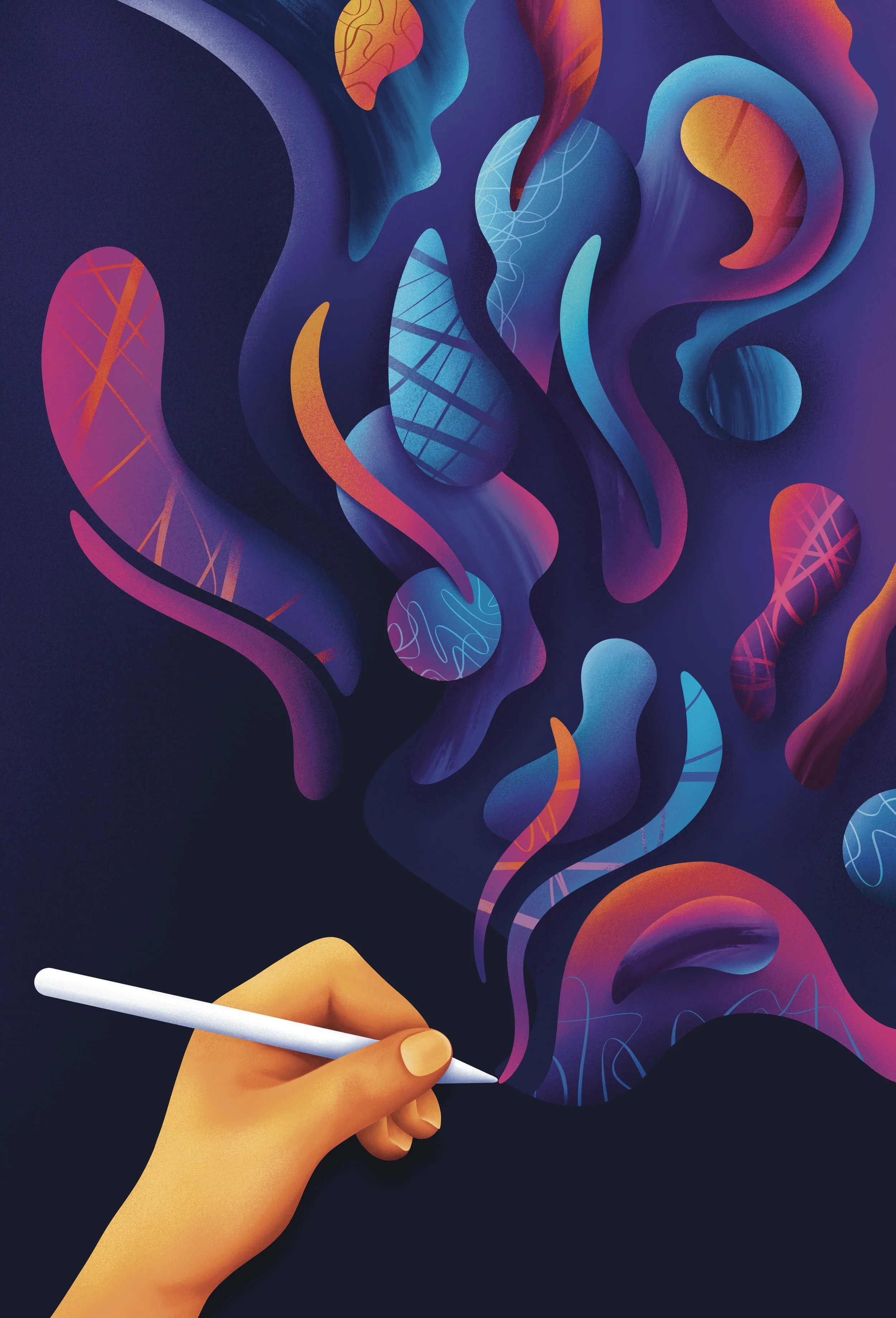
Illustration by @georgiabrownillustration
Ed Worley spent years living on the streets, after he was kicked out of his home while working at his father’s gallery. Homeless, his life turned into a repetitive process of finding a daily fix of cocaine and alcohol, in what he described as an endless cycle of insanity. He recalls drinking 10 litres of sparkling water a day to subdue the itch for drugs, having no thoughts for the future and feeling like a shell of a human being.
However, Ed managed to turn his life around. He’d loved graffiti art since he was 13, having been inspired by the idea that a person could design a large mural for the public to see, for free. He began developing his own personal style as a graffiti artist and is now a successful artist and the mastermind behind the label OPAKE. He accredits having a creative outlet for keeping him out of prison or the morgue. In addition to therapy, art functioned as his platform to recovery, as it helped him regain responsibility and a sense of purpose. Can art therefore be used to assist the process of trauma recovery? The answer seems to be yes.
The work of famous surrealist painter Salvador Dalí is filled with the colours red, orange, yellow and blue. While visually striking, these colours are more than what meets the eye.
You may recall his famous painting of the melting clocks, The Persistence of Memory, or the image of a tiger being thrust from the mouth of a fish in the painting, Dream Caused by the Flight of a Bee Around a Pomegranate a Second Before Awakening. Both artworks, famous the world over, are constituted of this specific colour palette.
“Dalí believed we have intra-uterine memory—memories of our time in our mother’s womb.”
He called intra-uterine memories the ‘colour of hell’, that is, ‘red, orange, yellow and bluish, the colour of flames, of fire’, as they represent both a place of safety, a place where we are warm, curled in a ball and safe, but also a moment of horror after we, as babies, are expelled from it into the bright light of the world. That feeling of expulsion is perhaps mimicked in Dream Caused by the Flight of a Bee.
Death is often metaphorically described as a bright light that guides the soul of the deceased away from the world, rather like how Dalí envisioned birth. It seemed to him that, in our birth, we also experience a kind of ‘artificial death’, of being released from that safe haven and forced to confront the world. To Dalí, those colours embody the moment he was stripped of a kind of peace and safety; he used colour to express that trauma.
It is thought that one in three people in the UK have experienced at least one traumatic event at some point in their lives, according to the Mental Health Foundation. A traumatic event can be described as an event that puts them or someone close to them at a serious risk of harm or death, and it is thought that around a third of those who experience a traumatic event will go on to develop post- traumatic stress disorder (PTSD).
PTSD can result in a host of symptoms including flashbacks, nightmares, high levels of associated distress, heart racing, sweating, feeling overwhelmed, difficulty concentrating, sleep disturbance, hypervigilance and more. Emotional dysregulation can also develop, where people have difficulty managing their emotions, meaning they may turn to drugs and alcohol, self-destructive behaviours and self-harm.
“Part of recovering from trauma involves processing the emotions and feelings generated by the traumatic experiences or event. Art is one avenue that can assist the processing of trauma.”
EMDR Consultant and Art Psychotherapist Lee Anna Simmons told The Human Perspective that while different therapists have their own ways of running art-based sessions, the art, rather than strictly words, becomes the vehicle for communication and expression. She posits that artwork can become a ‘third living entity in the room’ that can be used to explore and analyse feelings.
Lee described her iteration of an art therapy session. The process works by the client and therapist sitting down at a table laden with art materials, while the client is encouraged to create whatever comes to mind, and not worry about doing ‘technically good’ work.
The art provides a person with an outlet where emotions can be communicated and witnessed, bringing thoughts and feelings from the subconscious out into the world in a tangible form. This can provide a kind of ‘solace and relief, while also helping to make sense of things,’ by enabling a person to recognise what the marks on the page mean to them, as illustrations are often more about the particular feeling evoked in the image, rather than the subject matter itself.
Therefore, art can unlock ‘emotional remembering’, and allow a person to feel a sense of emotional release by expressing the emotions associated with a trauma through a safe outlet. The process of creation can also help people process emotions, which doesn’t have to be through mark-making, but also by ripping paper or using clay to express anger in a more creative way. Based on the wide variety of mediums and ways in which it can be used, ‘art can be a very helpful vehicle for expression of the unconscious and also of the actions that the body wants to take’.
The Human Perspective also spoke to Art Therapist Sophia Cowx, who added that art has the potential ‘to tap into sensory networks which connect body and mind,’ as well as temperature and other sensory cues of information inside the body. These sensory networks can be described as the first lines of engagement when it comes to making sense of ourselves in the world and our relationships with others.
Some have found using art to process such emotions profound and life changing. Ed, the creator of OPAKE’s cyclical artworks of layered and spiralling cartoons (below), produces hand- and spray-painted works that are mesmerising to look at, and reflect a snippet of his experience and message.
“To him, the artwork represents the ‘insanity’ that he experienced during his years of homelessness and drug use.”
He explained that he chose cartoons as a subject matter to represent ‘the total opposite’ of the trauma he went through. While the underlying message of his work is ‘quite dark,’ the outcome of the pieces is ‘always a fun image’, one that his loved ones can access and engage with. Although his paintings might have pops of only one or two colours, the colours present a contrast from that darkness he previously experienced. For Ed, the process of creating is meditative, which outweighs the outcome of each piece. As every line he draws must be precise, there’s no room for error, or ‘the background noise in your brain.’
Ed believes that using art to heal trauma is something that isn’t being tapped into enough, particularly as the creative process can be as simple as taking a pen to paper and doodling. The process has enabled him to launch his first solo exhibition in Quantus Gallery, and have his work featured in several major galleries in London, including the Saatchi Gallery.
Another London artist who also used art to recover from trauma is Clarke Reynolds (above), also known as The Blind Braille Artist. Clarke’s childhood was filled with domestic violence, alcohol abuse and bullying at school. While he physically lived in a council estate in Portsmouth, his sketchbook was his place of solace and his ‘best friend.’ He explained that as things were always sold when he was growing up, as his family needed the money; his sketchbook remained a safe space for him to escape to, as it was worthless to anyone else.
He explained he first discovered art on a school trip to a gallery, and that it would later go on to save his life. He shared that his brother had taken another path, and had passed away 6 years ago, at the age of 35, on a street corner.
Clarke left school at the age of 14 due to a problem with his kidneys, which meant he couldn’t use his hands to pick up a pencil; he described the experience as the ‘the hardest time in [his] life’, as he had lost the ‘backbone’ of his early years. He was also away from his family at the time, so didn’t have their support, and considered taking his own life. However, while recovery was gradual, he regained his movement and returned to his craft after a few months.
Clarke had only had vision in one eye since the age of 6, and went on to lose sight in his other eye in his early thirties. While more permanent than the damage to his hands, the process of losing sight was less traumatic for Clarke, as the vision loss made him ‘a better artist and a better person’ and taught him to how turn negatives into positives. In addition to caring for his young daughter, who had been diagnosed with mild cerebral palsy, Clarke continued to create, and he went on to launch his first solo exhibition in London last year.
Clarke has five-degree vision left in one eye, so he relies on the associations he has from his memories. Colours for each design are chosen based on the associations he has with his memories. The vibrancy of his artwork is a way for him to ‘regain the ability to see colour’ through memory, and has given him a purpose and a way to give back to the community. He has taught braille to children in schools and launched various solo shows and exhibitions. He hopes that children coming to his exhibitions can experience the same moment he felt in a gallery at the age of 6, and fall in love with the art that saved his life.
Traumatic events are often broken down into a ‘before’ and ‘after’ dichotomy. The impact of art is no different. Art provided both of these survivors with the ability to carry on, and regain a sense of joy and happiness in their lives. It’s vital that art, as with all forms of therapy, is kept within these same parameters. There is always an ‘after’, but that doesn’t have to be ‘the end’.