
Competitive advantage
Written by Isobel Clough
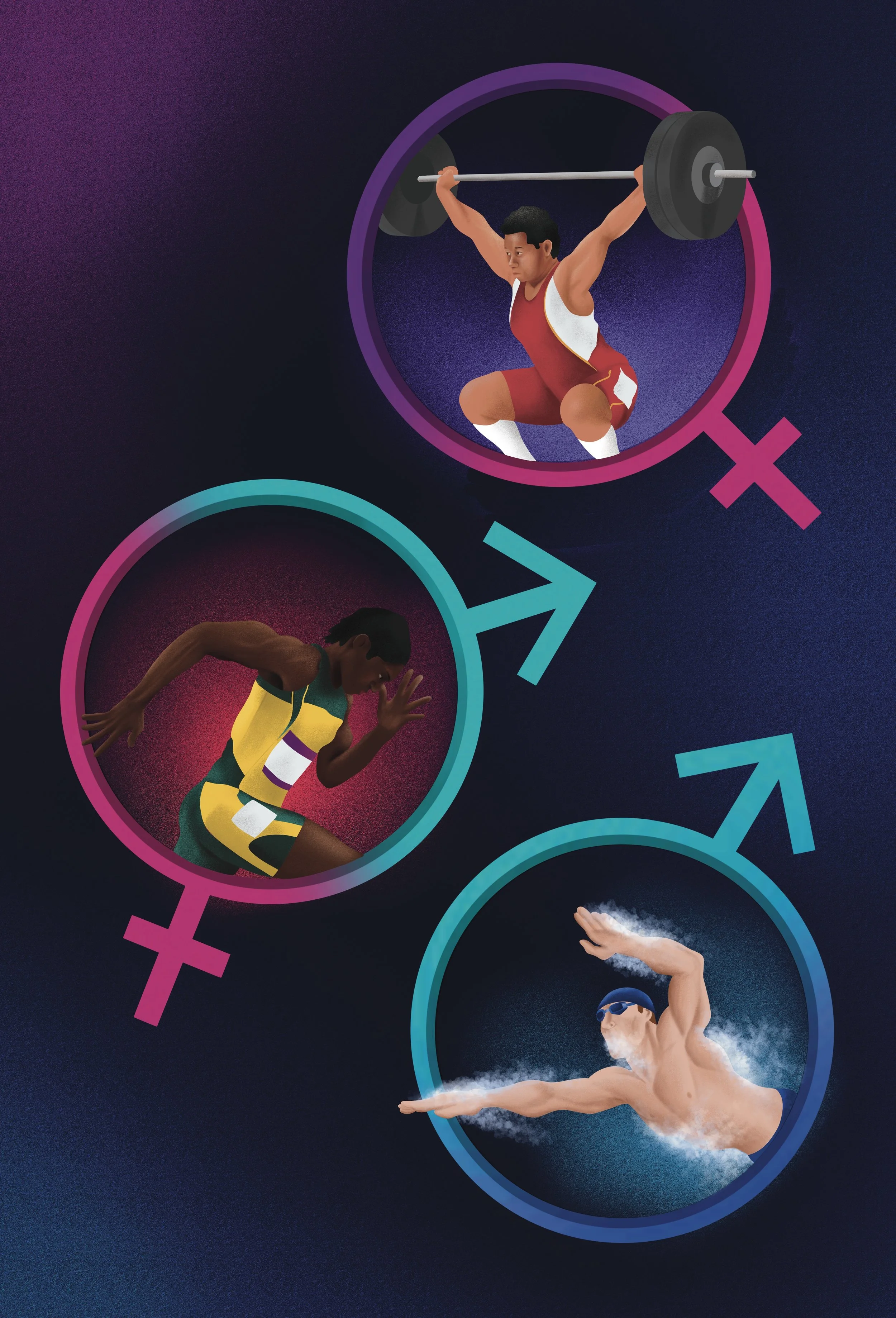
Illustration by @georgiabrownillustration on Instagram
Gender, as a concept, is evolving in western society. Once viewed as intrinsically related to biological sex, gender identity is increasingly understood as a construct, one that can be mistakenly applied, changed or denied depending on the individual, society or environment. Although western society is making steps in acknowledging the differences between sex and gender, many still find comfort in the idea that your ‘biological sex’ is fixed. This is understandable, as humans seek confidence and reassurance in how we categorise ourselves and the world around us. In the case of biological sex, people tend to point to physiological signs to ‘prove’ who belongs where.
However, the idea of a strict sex binary (male/female) is flawed. Around 2% of the world’s population exists ‘in between’ traditional definitions of the male and female sex. These individuals are typically grouped under the umbrella term ‘intersex’, coined by a geneticist to describe ambiguity in one or more factors used to define sex, typically related to genitalia and hormones.
Often, people who find themselves in between male and female sex will land closer to one category than the other. Medical advances, combined with the binary-hungry nature of society, means that many intersex people born in western countries will adjust their ‘ambiguous’ characteristics from an early age, and settle themselves as closely as possible to the male or female camp.
Others may simply have slightly higher or lower levels of certain sex hormones than average, making little to no difference to their outward appearance. In these cases, intersex traits may be inconsequential and invisible, and have little to no impact on the day-to-day life of the individual.
Intersex commonly refers to individuals who are born with atypical or conflicting physical attributes, which prevent them from being grouped under a straightforward definition of male or female. Examples of this can range from individuals who are born with both male and female genitalia, to individuals who live with hormone levels that are far above or below the ‘conventional’ levels expected in their presenting sex. For example, this could refer to a biological woman with testosterone levels exceeding 2.5 nmol/L.
“However, professional sport is a little different. Physiological differences are an important factor, and both are actively looked for and (usually) celebrated. As a result, athletes competing at elite level often have drastically different bodies compared to that of the general population. ”
Take Michael Phelps as an example. The American swimmer, who boasts a record-breaking 23 Olympic gold medals, has been described as having the "perfect body for swimming". Although hard work and rigorous training have undoubtably been crucial to his success, his physiological attributes have also played a role. Phelps’ ankle joints have been recorded as being 15% more flexible than that of his rivals, and his lungs can reportedly hold twice the capacity than that of the average human. Crucially, his cells also produce half the lactic acid than that of the typical Olympic athlete, which improves his recovery time and reduces his risk of fatigue.
While Phelps may be an extreme example, success in all sporting disciplines can be made more accessible by physiological attributes, or ‘gifts’. For example, basketball players in the NBA tend to be over a foot taller in height than the average ‘tall man’, while female distance runners are able to perform with a body fat percentage that, for many women, would lead to significant health problems.
Although a substantial proportion of an athlete’s success lies in training and other external factors, at the very top level, abnormal genetics and physiology can be fundamental to success.
“So, physical attributes can make sport and athleticism more straightforward. Yet, they can also make it far, far more complicated. ”
Modern sport has gender and sex binaries embedded in its culture. At the top level, the vast majority of competitions will either divide events into male and female categories (as in international athletics, swimming, gymnastics, etc.) or hold entirely different tournaments for men and women (as in football and golf). This division typically starts long before an individual reaches professional level – most schools split up boys and girls for PE classes, and many amateur clubs will be made up of men’s and womens’ teams.
The reasons behind the sex binary in sport are at least partly socio-cultural. Men and women being separated can improve accessibility to specific disciplines and be essential for the sake of fair competition. A male weightlifter will likely be able to lift substantially more than a female competitor, while a female gymnast could perform a greater range of acrobatics and manoeuvres in a balance beam routine compared to their male counterparts.
These divisions are designed to play to the strengths of male and female sex. While both require an almost unimaginable level of talent and skill, each specific technique and style are designed to show off the best of different physiologies. But what if an athlete’s body exists in between the defined limits of male and female sex? How do you reconcile an intersex athlete with a sporting discipline that places strict limitations on what physical characteristics a competitor can have?
The regulatory bodies that govern professional sport are still struggling to answer this question, leaving the careers of many intersex athletes – also referred to as individuals with ‘differences of sex development’ (DSD) – hanging in limbo.
World Athletes, the international governing body for athletics (sprints, high jump, javelin, etc.), has faced controversy over the last 15 years for their attempts to solve this issue. In 2011, the body published their first regulations on testosterone for female athletes. In 2019, these rules were updated, stating that athletes deemed to have DSD must maintain a serum testosterone level below 2.5 nmol/L to be eligible for a women’s middle-distance race (400m to 1 mile) at a World Rankings Competition, such as the Olympics. Athletes with DSD can be required to medically suppress their serum testosterone to meet the required levels.
This ruling led to some athletes moving to shorter or longer distances. Francine Nyonsaba, an athlete with DSD from Burundi, won the indoor 800m finals in 2016 and 2018, but had to switch to the 10,000m after the 2019 regulations were introduced. She went on break the world record for the women’s 2000m in 2021.
However, in 2023, World Athletics announced that the 2.5 nmol/L serum testosterone limit on women’s categories would apply to athletes with DSD across all events. For intersex athletes previously competing in female categories, there is essentially nowhere to go – they must either leave their career or take medication to bring their bodies within what World Athletics deems the parameters of the female sex.
The case of another athlete, Caster Semenya, demonstrates the complexity of associating strict physiological definitions of sex with sport; for Semenya, the boundaries of what made one ‘female enough’ to compete in women’s athletics changed over the course of her 10-year career. But if elite sport requires athletes to be female enough to compete in the women’s categories, does that mean those wishing to compete in men’s categories must be ‘male enough’? Or are some types of ‘in betweenness’ more acceptable than others?
There is precedent for an athlete with DSD being allowed to alter their hormone levels to compete in a male category. In 2016, Brazilian swimmer Pedro Spajari received approval to take testosterone supplements after discovering that he had Klinefelter syndrome, a type of DSD which reduces testosterone levels. Since starting this medication, Spajari has won a gold medal at the Pan Pacific Swimming Championships and qualified for the Olympics. For him, moving out of the in between meant removing a possible disadvantage associated with a genetic condition.
For intersex individuals wishing to compete in female categories, the outcome of moving out of the in between (at least in terms of hormone levels) may be less desirable. The fundamental purpose of the regulations on testosterone is to remove a natural advantage that an intersex person may have over athletes of the female sex. For individuals with DSD competing in women’s categories, taking medication to lower testosterone levels could be seen as similar to Michael Phelps wearing a wetsuit that limited the exceptional flexibility of his ankle joints. He could still be a champion, but he may not reach the full potential that his natural physiology would allow.
Spajari is currently the only known Olympian with DSD to compete in a male category. Should we assume that this is because lower testosterone levels prevent most intersex individuals from making the cut for male elite sport? Not necessarily.
Despite the common belief that higher testosterone equals better performance, some research has suggested that this association isn’t quite so straightforward. One study found that around 25% of elite male athletes had low testosterone levels, with substantial differences between types of sport.
Another possible explanation for women appearing to be overly represented in DSD cases could be that sex testing in professional sport has historically focused on female categories. Until the late 1990s, athletes competing in a female category were subject to mass testing, regardless of whether they had a DSD diagnosis.
The original sex verification tests introduced in the 1950s were given the crude but apt nickname ‘nude parades’, as they required female athletes to undress and be examined by a gynaecologist. This was replaced with genetic tests in 1968, focusing on the presence (or lack thereof) of a Y chromosome, while modern tests examine both genetics and hormone levels.
Yet, the spotlight is still very much on women’s categories. DSD is not always obvious externally, so an athlete may have no idea of their condition until they reach a point in their career where their sex is questioned. It follows that some athletes competing in male categories may have DSD – we simply aren’t looking for it.
In this way, the implications of being intersex seem to differ substantially depending on which of the two binary categories the athlete falls closest to – male or female. For those who fall closer to the female camp, sex is far more likely to be questioned and the result could be career ending. Yet, it can be argued that both the approval of Spajari’s testosterone supplementation and World Athletics’ regulations on DSD in female categories have the same objective: to bring athletes out of the in between.
Arguments have been made for alternative solutions to accommodate intersex athletes, including the total abolition of sex segregation in sport. Others believe that sex verification should be abolished, allowing people who have grown up as women to compete in female categories. This would mean that elite sport could ignore ‘inbetweenness’ in biological sex altogether and maintain its binary structure.
However, both options could be considered unfair for non-intersex female athletes because of the physiological advantages associated with male sex characteristics.
It is also worth noting that, thus far, individuals with DSD who have competed in female athletics categories would not have been competitive in male categories. Therefore, abolishing sex segregation entirely would likely see elite competitive athletics return to being the exclusive remit of the male sex.
But this also raises the question: is the concept of the sex binary so strongly entrenched in sport that the only possible alternative to upholding it is abolishing sex-based categories altogether? Some advocates for intersex inclusion have suggested creating a third category specifically designed to accommodate athletes with DSD.
Theoretically, this would allow intersex athletes to compete to their fullest potential, removing any risks related to hormone medication, while upholding the ethos of fair and safe competition in the female category.
However, this would require a clear, unanimous definition of ‘intersex’, which does not exist – there is still debate around the exact characteristics of male, female and in between, with parameters changing over time. Also, creating a whole category for those with DSD could be stigmatising for the athletes, as it would highlight their differences on an international stage.
In an ideal world, this would be a non-issue. In reality, it could lead to a variety of personal and social problems for the athletes and, given societal taboos around sex, may even put their safety at risk.
Another possible solution could be to abolish the binary male and female classifications, replacing them with two new categories: ‘biological female’ and ‘everyone else’. If given gender neutral names (e.g. ‘Category A’ and ‘Category B’), this could help to accommodate both intersex and transgender athletes, while maintaining fair competition for those who fall within the parameters of female sex.
That said, the practical and ethical problems highlighted above would also apply to this approach. Moreover, it is likely that the ‘everyone else’ category would be dominated by biological males, so intersex athletes who are closer to female physiology may still struggle to find a place in competitive and professional sport.
Far from being simple and clear cut, biological sex is the centre of a complex physiological, practical and ethical dilemma. What's more, we don’t have answers for all the questions raised. For now, a version of elite athletics that embraces inbetweeness is difficult to imagine; sex binary is not only culturally embedded, it is also integral to the existence of female professional sport.
Whether governing bodies would be open to testing some of the aforementioned alternatives remains to be seen. However, one thing is clear: sporting authorities need to work to reduce the psychological harm caused to athletes, whose physiology is at risk of being put on display for all the world to see.