
Box fresh, blood stained
Written by Jasmine Laws
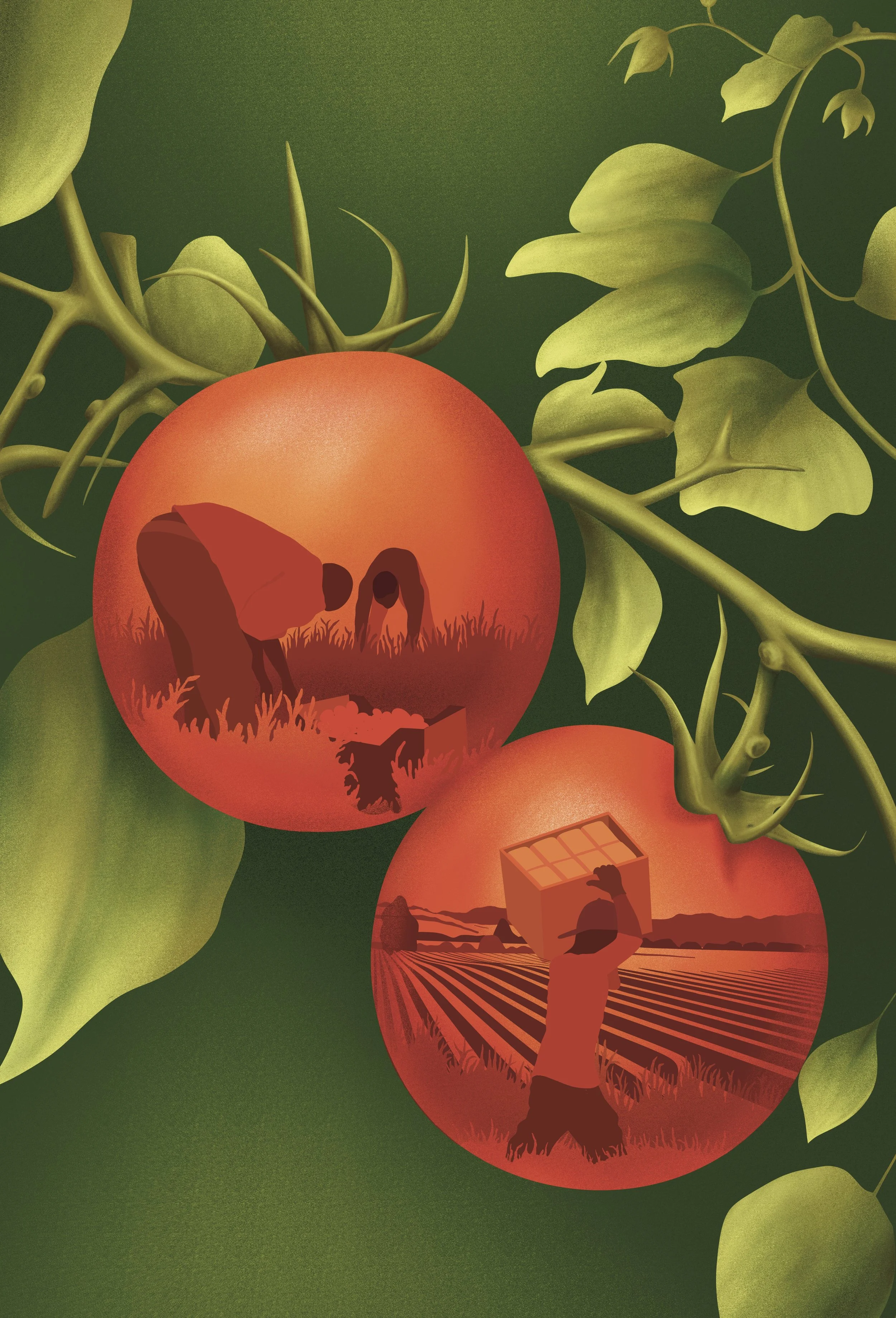
Illustration by @georgiabrownillustration on Instagram
They sit in green or black crates, piled on top of each other, like glowing red moons. You can find them in jars on supermarket shelves, liquidised on top of your pizza or blending into spirals of fusilli in your evening meal. Tomatoes.
When we think of tomatoes, we think of the Mediterranean, and more specifically, Italian cuisine. The embodiment of ‘la dolce vita’, the richness of a single Italian tomato precedes that of which we grow in the UK. Their freshness is unequivocal. Such a delicacy can only be grown and picked by the finest pairs of hands; it is impossible to produce them synthetically by mass machinery.
Yet, at what cost? Only a short drive from the charismatic towns of southern Italy, the farmlands of Puglia, Campania and Basilicata remain stiflingly quiet, concealing the coercive labour that surrounds the country's famed tomatoes.
There are more than 400,000 seasonal, agricultural workers in Italy, according to the Federation of Agricultural Workers. Most of the workers are reportedly from Gambia, Ghana, Nigeria, Sudan and Somalia, with some coming from Eastern Europe.
“The farmlands remain stiflingly quiet, concealing the coercive labour that surrounds the country’s famed tomatoes.”
The number of migrants and refugees arriving has been increasing. In 2023, 157,651 people from 62 different nationalities came to Italy by sea – a 50% increase on 2022. Given that, in 2023, economic migrants made up 27% of the total Italian workforce (370,000 people), it is likely that the opportunity to find labour is a significant pull factor to the country. A substantial proportion of this migrant workforce find a home in Italy’s agricultural sector, which reportedly employed 200,000 non-native workers in 2020. This figure does not include those undocumented labourers working there illegally.
This migrant population is essential to Italy’s export and domestic markets. The country is experiencing a drop in its national labour force, due to its aging population and decreasing birth rate. The IDOS Study and Research Centre estimated that if Italy wishes to remain consistent in its agricultural production, it will need to employ the services of 280,000 foreign labourers every year until 2050. This demand has resulted in migrant workers having even greater opportunity to find work.
However, the labour opportunities available are typically suited for low-skilled workers, and their salaries can be as low as 25% of the national average, leaving the workers to often live below the poverty line. In relation to jobs on tomato farms, many of which are undocumented, the situation is even worse. Working on tomato farms, labourers often go unpaid, and can be routinely threatened with death and sexual assault. According to the Istituto Nazionale Assicurazione Infortuni sul Lavoro, around 1,500 migrant workers died between 2012–2018 as a result of living and working in inadequate and harsh conditions. These conditions have been described by the workers themselves as: "hell". The charity Médecins Sans Frontières, typically a provider of medical aid in conflict zones, has on occasion been summoned to support workers battling skin, respiratory and gastrointestinal illnesses, as well as those who have been attacked, violated or racially abused.
Some migrants die from colds or poor health. Some die at the hands of police. Some burn to death in the fires that occasionally rip through their shacks, built from plastic, paper and other bits of scrap. On the night of 27 January 2018, 2,000 people fled to escape the flames that erupted at their squatter camp in Rosarno. There was another incident on 6 August 2018, where a van full of migrant farm labourers slammed into an oncoming truck and somersaulted across the tarmac, killing 12 of the men packed inside. Just 48 hours earlier, a near identical crash on a neighbouring road killed four other African workers as they returned home from the tomato fields.
Barely surviving on a daily wage of between €22 to €30 for a 10- to 12-hour day, less than half the legal Italian minimum wage, labourers have little choice but to rely on their employers, many of which use the ‘caporalato’ practice: the illicit system of exploiting labour through illegal intermediaries (gangmasters).
Foreign labourers need protection and income, and are often estranged from the local communities that they work alongside. Many live in fear they could be sent back to their home countries, and are forced to rely on gangmasters for transportation, accommodation and payment.
As seasonal workers are employed under short-term contracts, they have little job and social security, with many coming from poor, vulnerable regions and being unaware of their rights. These factors make the enforcement of human rights tricky among the migrant labour communities, as many do not wish to ‘rock the boat’ through fear of reprisal.
In conversation with The Human Perspective, Italian human rights campaigner Diletta Bellotti explained that Italy’s tomato industry is based on a “deep and disposable labour force of marginalised people”. She continued that: “The reason why there is still slavery and severe exploitation in tomato fields is tied to the exploitative market economy, where the violence is against undocumented people. The industry is considered to be low-skill labour and therefore attracts undocumented migrants.”
This is something that Jakub Sobik, Communications Director at the Modern Slavery and Human Rights Policy and Evidence Centre, corroborated. In an interview with The Human Perspective, he explained how the issue stems from the “vulnerability” of those who “get exploited through forced labour [and who] are typically desperate to find some money and sustain themselves and their families”.
However, given that they have “no legal status”, the workers can’t find legal jobs and “certain agencies that operate outside of the official systems can take advantage of that”.
“In 2015, the modern slavery practices were linked to a number of global organisations that sell tomato sauce in multiple supermarket chains in the UK.”
In 2015, the modern slavery practices were linked to a number of global organisations that sell tomato sauce in multiple supermarket chains in the UK. That year, the brands Mutti and Princes Group were implicated in a court case after Abdullah Muhammed, a 47-year-old Sudanese immigrant father of two, had a heart attack while working on the De Rubertis farm in Nardó, southern Italy, and died. He passed away in the soil of his workplace after being refused medical attention. His death could have been avoided.
In the wake of his death, Yvan Sagnet, president of No Cap, the organisation evaluating goods’ production conditions and ethicality, helped the Italian prosecutor Paola Guglielmi by investigating transport documents throughout supply chains to connect the Nardó farmland with the supplier of global brands. He told The Human Perspective: “It emerged that the company provided its tomatoes to four large groups: Conserve Italia, La Rosina, a company from Campania, Mutti, and the other, from Foggia, Princes.”
While consumers of these products have little capability to shut down an exploitive system that has been present for decades, Mr Sobik stressed how customers in stores like Waitrose, Tesco and Sainsbury’s, have an opportunity to break the silence on these antics.
He emphasised the “responsibility” businesses have to “check whether products are affected by exploitation and forced labour”, while “governments have a role to play in making sure that businesses do that”.
Given that Italian tomatoes account for 60% of the tomatoes sold in the UK, the Ethical Trading Institute have provided a report detailing the scope of the problem to help food retailers “secure decent working conditions in their supply chains in Italy”. However, Mr Sobik argued there is also a responsibility of the customer to inform themselves about whether the products they are buying are ethically sourced.
With climate change worsening and scorching the agricultural landscape of the Mediterranean, this problem appears set to worsen.
Italy’s production of 70,000 hectares and 6 million tons of tomatoes is being threatened with a decrease of 0.4 tons per hectare in Foggia for every degree the temperature increases. By 2050, the agricultural yield decrease in Foggia is expected to be 18%.
The concern remains over what impact this will have on the labourers in the farms. Given that demand won’t decrease along with the available supply of tomatoes, labourers may be forced to work harder to continue meeting previous yields. Working under the radiating heat of the Mediterranean sun, they would be confronted with life-threatening working conditions.
This is something Ms Bellotti expressed her concern over in discussion with The Human Perspective, saying: “Picking tomatoes in the hot season has simply brought more people to death”.
In discussing the problem, Matteo Salvini, the country’s Deputy Prime Minister, previously referred to immigrants as the country’s “new slaves”, allegedly as a strategic move to dissuade more from coming to Italy. Salvini’s 2018 anti-immigration security decree, which he claimed would enable Italy to become stronger “in the fight against the mafia and (people) smugglers, reduce the costs of excessive immigration, expel delinquents and fake refugees, strip terrorists of citizenship, (and) give the police greater powers”, instead was reported to exacerbate the situation, as the number of irregular migrants entering the country increased.
A year later, he passed a law to ensure private vessels carrying migrants into Italian waters would face fines of up to 1 million euros, alongside the arrest of the captain and confiscation and possible destruction of the ship. This was passed only days after 150 migrants died as the boats they were travelling on capsized when crossing from Libya to Europe.
As the law passed the Senate, a ship with more than 100 rescued migrants on board was stranded for around 3 weeks after being unable to dock in Italy or Malta. His immigration policies have remained controversial from the start, and continue to inflame debates on the issue, with little success in improving the situation for migrant workers.
As a result, migrant labourers have been left to fend for themselves, becoming even more vulnerable after losing their basic protections. This has pushed more workers into the arms of the gangmasters, where they become trapped by the need to work and the lack of ability to communicate with local authorities, given the restrictions they face under the caporalato system.
The lives of tens of thousands of labourers hang in the balance, as the Italian government is unable to control the caporalato system, which has integrated itself into the foundations of Italy’s agricultural sector.
One report titled: "Made in immigritaly” found that immigrant workers were behind at least half of all food products made in the country in 2022, despite government data indicating that only 362,000 immigrants had worked in the food sector for 31.7% of that year.
The invisibility of working conditions within the supply chain leaves a vacuum of space between the tomatoes growing in the rich soil of southern Italian countryside, to the shelves of your cupboards. With the welfare of labourers falling between the cracks of government control, the issue demands greater action to be taken from all parts of the supply chain, from retail stores all the way through to the Italian government. Resolution of the issue requires holistic effort, from the bottom-up. For you, all it takes is choosing your tomato sauce a little more carefully.