
Political binaries
Written by Ethan Gray
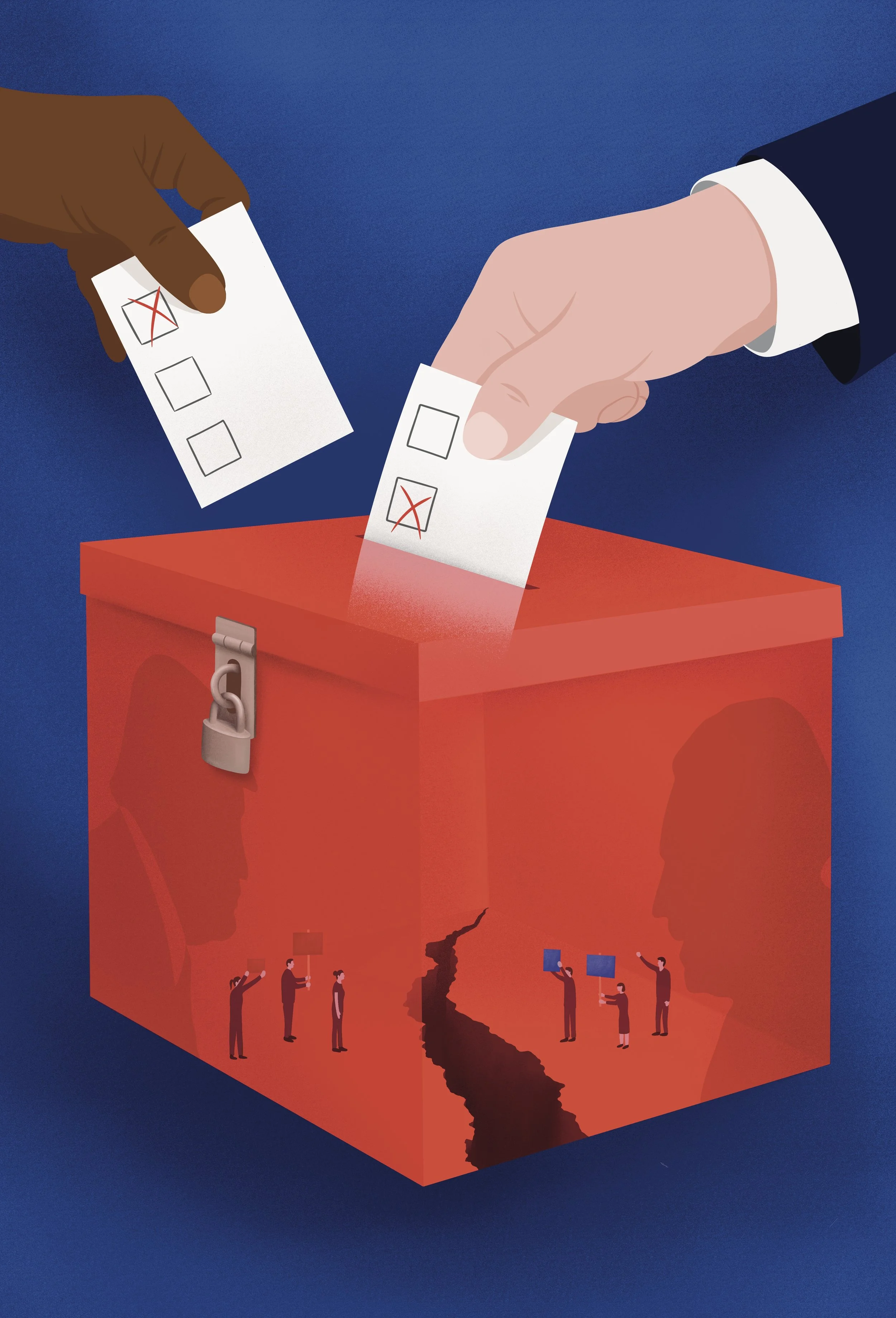
Illustration by @georgiabrownillustration on Instagram
Political pundits love to discuss left versus right in the 21st century. It’s like a modern-day Shakespearian drama. Politicians present themselves as the only hope for their chosen political faction, commentators paint each election as the "the most important in history" (until the next one rolls around) and the average voter gets bombarded with messaging until they’re enraged, depressed or apathetic.
Polarisation and political sorting are rife in today’s landscape. Political sorting refers to the party in which individuals align themselves to represent their views, and political polarisation is where political opinions on specific topics become more extreme. Both factors harm our domestic and international institutions, and reduce the capacity of our governing systems to function. When viewing them through the lens of ‘between spaces’, two key aspects become apparent: the actions of political parties are becoming increasingly distant from their supposed purpose, and voters with opposing views are progressively isolating themselves from one other.
Since the turn of the century, growing political animosity between conservative and liberal coalitions has become increasingly evident. While the specific parties differ between countries, the trend remains the same across much of the Western world. This article will focus on the U.S. context.
So, to start. Several reasons can help explain why polarisation and sorting are increasing in the U.S. News has become increasingly nationalised and less local. This has, in effect, led to the growing detachment of individuals from their local communities and forced every issue into a national frame of reference – even though local politics generally impact voters more.
“Social media delivers voters’ content, with algorithms reinforcing specific perspectives that they perceive to be your content preferences”
Partisans on either side post what garners the most attention, not the most reasonable course of action. Globalisation gutted rural and industrial areas, leading to mistrust of America's globally interconnected economic model.
Those with college degrees, who are overwhelmingly more liberal, increasingly centre themselves in cities, which leads to the physical separation of rural and urban ideologies. While there are several other causes of growing political sorting and polarisation, the result of their combined effect has been the creation of “super identities”.
Modern conservatism in America is increasingly populist. Modern liberalism is more challenging to characterise, but often, all left-leaning ideologies are bundled together under "woke" politics. A catch-all term that is devoid of concrete meaning in a policy sense, and instead captures the conservative view that liberals are in favour of cancel culture, open borders, defunding police and pushing the “LGBTQ agenda”, to name a few. In both cases, the two parties' rhetoric barely captures the traditional views associated with the terms conservative and liberal. Conservatism was once analogous with small government, fiscal restraint, free markets and American internationalism abroad. Liberalism supported free markets and America's international engagement but had an emphasis on more progressive cultural values and a more interventionist state. Both parties have taken some of these historically held beliefs to the extreme or, in some cases, entirely abandoned them.
At their core, the terms “liberal” and “conservative” have become epithets for either side of an ideological chasm. Identities have been reduced to a set of beliefs that are not representative of the people behind them, and there appears to be little space to learn or grow from experience.
Political parties have leaned into this new reality. Despite their rhetoric, both Republicans and Democrats love the status quo because they only have one competitor. Not all, but many politicians are principally motivated by an incentive to stay in office. Their actions are unsurprising, considering they have no competition beyond a primary challenger or the other party, unlike countries with multi-party systems.
In many cases, major concerns and policy matters are reduced to opportunities to score political points. In March, for what can only be reasonably explained by 2024 electoral ambitions, Congressional Republicans torpedoed a deal for border security at the behest of their likely presidential nominee, so they could continue to blame Democrats for “doing nothing”.
While President Biden has accomplished some impressive legislative feats, including massive investments in infrastructure, renewable energy, chip technology, and some gun control, his age and handling of the southern border are turning off swing voters and partisans alike. What’s more, while his party claims to have been for “democratic values” in America's elections, they routinely employed efforts to crush all attempts to challenge his leadership, until his position became untenable.
“Party machinery has made it incredibly difficult for any alternative to get on the primary ballot despite widespread discontent among voters with the president. ”
The political reality in America is voters only have two credible choices. With no legitimate other options, each party can feed into partisan extremes with no accountability to the moderate voter, who is often less politically engaged. Staunch partisans are likelier to show up for primaries, so candidates must appeal to them, especially in districts where the other party has no hope of winning.
In a recent TED talk, Andrew Yang discussed the fact that Members of Congress have a 94% re-election rate and a 15% approval rate. Citizens hate how the body functions but rebuke their representatives when they reach across the aisle. America's electoral infrastructure needs more space for alternatives and moderates to stand. The unpopularity of the two presumptive party candidates in 2024 has led to Robert F Kennedy Junior (RFK), an independent, garnering 15% of the national vote in some polls.
For voters not captured by the extremes, it has become a choice of the lesser of two evils. As the space between the parties has grown, voters' choices feel more dire. Each election season has become a fight for the soul of America. The rhetoric is exhausting. Even writing this feels like a slog.
Partisan sorting and the increasingly polarised views of each side on inflammatory issues combine to manifest themselves in institutions in increasingly dangerous ways. In media, conservative outlets and pundits have gotten increasingly conspiratorial and often paint authoritarians like Viktor Orban or Vladimir Putin in a positive light. Fox News, fringe outlets like OAN, and independent "journalists" on Twitter discuss Donald Trump as if he is a saviour for the common man fighting against the deep state. In reality, he is a well-connected billionaire exploiting campaign donations to service legal fees and has also attempted to circumvent the peaceful transfer of power.
Right-leaning pundits are also quicker to pick up and spread false stories. Candace Owens, a conservative commentator, pushed a fake story that Volodmy Zelensky’s wife went on shopping sprees ostensibly with aid sent by the West. Their incentive is to play on the fears of Americans and culture war topics to increase ratings, clicks and personal income by any means.
More liberal outlets such as the New York Times, once viewed as a relatively unbiased source of news, are increasingly concerned with appeasing their left-leaning audience. In an article from December 2023, James Bennett, former NYT opinion editor, wrote, “The Time’s problem has metastasised from liberal bias to illiberal bias, from an inclination to favour one side of the national debate to an impulse to shut debate down altogether”.
“Toxic political culture is clearly having deleterious effects on the government as well. ”
Transformative laws are seldom passed conventionally, as partisan fights spill into the legislative process. A few miraculous bills have managed to be signed into law since 2020, such as the Chips Act, which invested in domestic semiconductor manufacturing, and the Inflation Reduction Act, which primarily invested in green energy infrastructure, have managed to get signed into law. But they are outliers. Meaningful legislation on critical issues must be passed on party lines or forced through spending bills via budget reconciliation.
The dysfunction leads to real-world harm, as the Republicans and Democrats are unwilling to create space for common ground out of fear of giving the other side a win and addressing the root cause of serious problems. America's foreign policy is fraying on party lines as well. Allies around the world view a once-dependable partner with growing scepticism, because administrations lack threads of consistency. It is harming not only America's interests but also global security. Trump has endangered NATO by threatening to not come to the defence of members should they not hit their spending targets. Party oscillation on support for Ukraine has given Putin reason to believe he can simply outlast Western support of democratic countries. Domestic dysfunction is causing mistrust of American will abroad.
So how is the space between voters, politicians, and the conversations each circle isolates themselves in bridged? Some more liberal journalists and comedians are pushing back on more extreme views. John Stewart and Bill Maher are willing to converse in the space between ideologies. Questioning the ethics of cancel culture and political correctness, as well as more controversial issues such as conversion therapy for minors. Further space like this for questioning beliefs must be opened on the left. Citizens are also taking action with their vote, such as ousting the San Francisco DA, who implemented some left-wing policies that contributed to a spike in violence and robberies in the city.
Modern conservatism, unfortunately, finds itself in a more dire state. Elected Republicans once again find themselves captured by fear of Donald Trump and an unwillingness to challenge him.
Right-wing media and pundits have fallen in line. Courage is needed in individuals to challenge him and his most ardent supporters, whose views disregard democratic values and view international relations as a zero-sum game.
So, what can be done? Structural changes offer more immediate solutions for shrinking the space between partisans. A shift from first-past-the-post voting to ranked-choice voting (RCV) would encourage candidates to seek broader support from the voter base, and reduce the amount of “wasted votes”.
Non-partisan primary systems are a great compliment to RCV. In this structure, voters can choose one candidate from any party they wish to see in the general election. Candidates do not need to be endorsed by their party to be on the ballot. This allows more moderate candidates to advance through the primary as they do not necessarily need to pander to the most partisan elements of a party's base. In other words, you don't need to sell your soul to one party or the other. →
→ In 2022, Alaska successfully implemented RCV for general elections and a top-four non-partisan primary system. Elements of proportional representation, commonly used in Europe, could also be experimented with. There are several types. In Germany, for example, mixed-member proportional representation (MMP) gives voters one vote for a representative of their respective district and one vote for a political party. A portion of the representative seats are allocated to the party vote. Those seats are then distributed based on the percentage of votes each party received nationally, as a result, the government is made up of a more diverse crowd of officials.
Removing the filibuster within the Senate would allow the ruling coalition to govern. It should also incentivise the minority party to negotiate in good faith, hopefully leading to more moderate bipartisan legislation. It will also allow voters to see the types of policies each party would pass if procedural rules did not hamstring them, allowing them to make more informed decisions during the next election cycle. None of these potential solutions are easy, nor are they silver bullets, but change is necessary.
“These are some of the options we’re left with. There are certainly more. I would rather not imply this is all we can do.”
Societal problems amplified by partisan media outlets are hard to tackle, as their financial incentives go against several possible solutions.
Still, some options include social media companies increasing clarity around how algorithms sort content based on user preference. Even better, they could allow users to tune their algorithms if they wish to see content outside their typical bubble, or turn it off entirely. Frustration and distrust with legacy media are growing. There is a growing market for a return to journalism and news that does not so blatantly pander to one side or another. If that incentive gains enough traction, new institutions may rise to fill the gap, or step forward and pull existing ones back to a semblance of normalcy. At times, the space between groups in American politics feels as though it is irreconcilable. A chasm of hateful debate between partisans drowns out moderates or voters with views that overlap.
In reality, there is growing consensus across several issue areas that politicians and voters can agree on to advance the well-being of Americans and countries abroad. A large racially and culturally diverse democracy like the United States only functions if the electorate can find threads that link them across their differences.
It is possible for the country’s electorate to have a shared story and understand nation's faults and imperfections, while continuing on a path of progress.
There are inevitable setbacks, but it is hard to argue that today is not the best time to be alive in aggregate, when compared to any other time in history. The moderate voter has lost their voice in contemporary politics. They don't capture the controversial headlines, and the space between them and those who dominate the political conversation on either side is massive. But as the extremes sort themselves on the poles, the number of people alienated by both parties and their polarising ideologies will grow. America's current state is distressing, but it has been dozens of times in the past.
As our political and social culture adapts to life online and extreme politicians are seen as useless in Washington, I hope that citizens will drive our system towards some structural changes.
The moderate voter is a political outcast in America, bombarded by either side for not agreeing with every belief thrown their way. The world is too complicated to reduce every issue to a Democratic or Republican, or conservative and liberal. It's a lazy way to interpret the world and fits issues into pre-existing biases.
Incentives in America's institutions do not favour them. Still, moderates must reassert a semblance of reason back into American politics. If they should fail, or simply bury their heads in the sand, the space between citizens will continue to grow.