
Violent past, joyful present
Written by Bea Hale
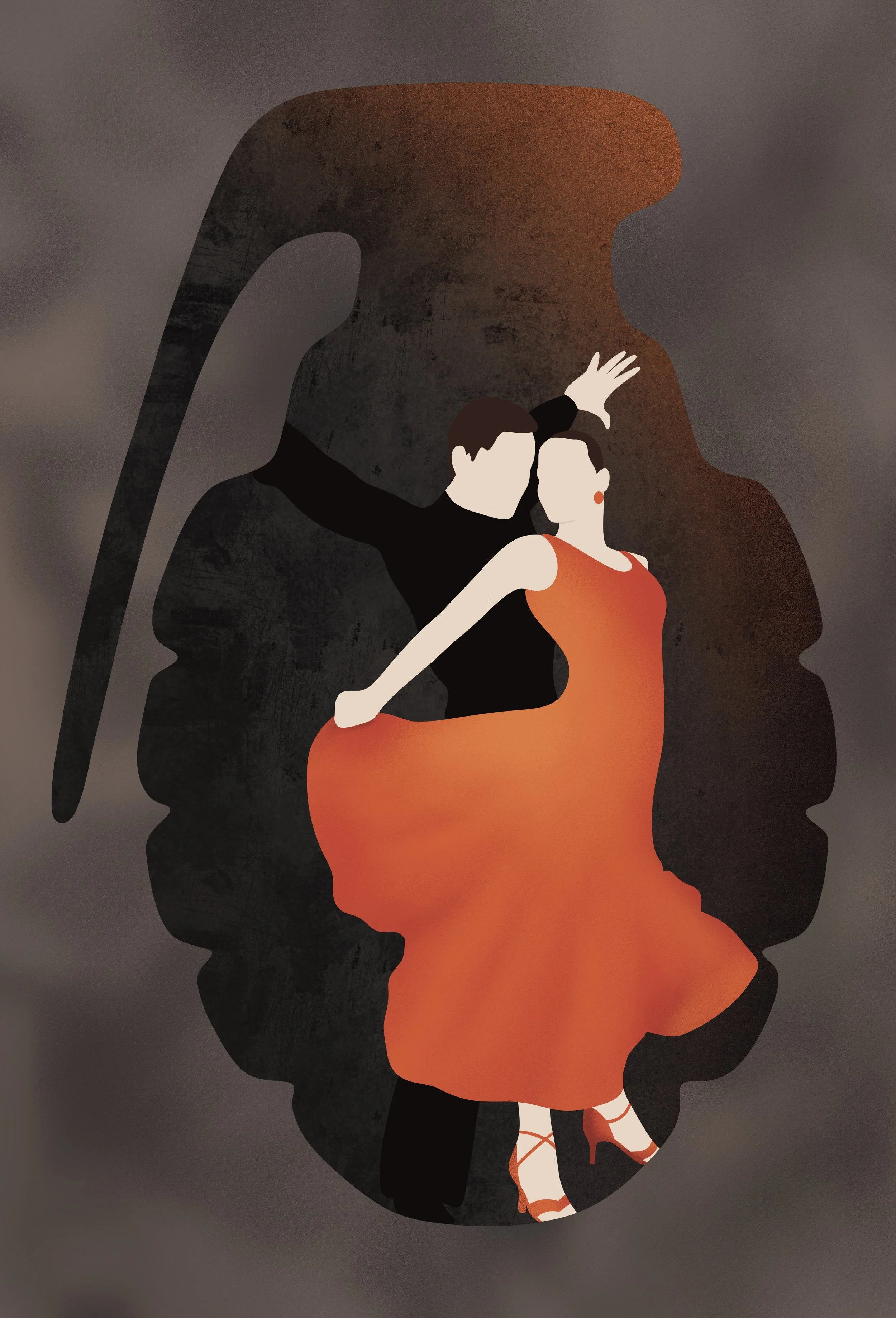
Illustration by @georgiabrownillustration
I have been living in Bogotá, Colombia since February of this year (2024). Colombia’s reputation remains pretty firmly etched in the minds of Westerners as a country rife with violence, whose politics is dictated by armed conflict due in large part to the lucrative and ruthless cocaine trade. This caricature of a reputation is no longer justified: Colombia has enjoyed relative peace after the signing of the Peace Agreements between the government and the Revolutionary Armed Forces of Colombia (FARC) in 2016. In addition, it is currently ruled by the democratically elected President Gustavo Petro, the first ruling leader of a left-wing party. So, Colombia enjoys relative stability, and the situation has drastically improved in comparison to the period of conflict that gripped the country post-1948.
However, there remains large swathes of the country, in regions such as Arauca, Cauca and Norte del Santander, which operate essentially outside of the government’s control. The economy is steadily declining (according to the World Bank, GDP has declined from 7.3% in 2022 to 1.2% in 2023) and homelessness rates are facing record highs after the pandemic.
When thinking about intersections and spatiality, I immediately thought about the dissonance between this country’s violent history, its continued suffering and the joy that seems to characterise the daily lives of Colombians. This is an anecdotal observation, representative of my experience living in and occupying the space of, realistically, 15% of a city that houses 11.6 million people, divided sharply into the lucrative North and neglected South. My experience throughout Colombia, although not, I hope, comparable to those of a Medellín dwelling digital nomad, are nonetheless limited to those of a Western traveller, as are my observations of daily joy, laughter and dance. Following this disclosure, here are my experiences of the intersection between joy and violence in Colombia.
“There is something about Bogotá that holds me captive.”
It is not any sense of obligation or a life tied to a particular job – it's the city itself, with its deceptively sunny mornings that twist into turbulent afternoons, the overflowing wheelbarrows of avocados the size of ostrich eggs that cruise streets or lie in waiting outside supermarkets, and the incessant, vibrant chaos that never seeks your approval or tries to impress. Bogotá has its own rhythm, indifferent to your presence, unfazed by your departure. It is a city and country which demands your attention yet seems wholly disinterested in whether you stay or leave.
This is a country that dances on the edge of darkness. Its violent past (and present) casts long shadows over its politics, society, and daily life. But what’s intriguing, what makes Colombia unique, is the sheer vitality that bursts through those shadows. Nowhere is this more evident than in the streets, clubs, and rooftops where Colombians dance their way through life.
Salsa, cumbia, bachata, merengue, reggaeton, vallenato – the music is as diverse as the country's landscapes. It echoes from the rooftops of Bogotá to the coastal towns like Santa Marta, where DJs mix salsa songs that seamlessly shift into Rihanna's S&M, a change of rhythm which does nothing to impede the flow of steps, the melting of hips or the exchange of partners.
In Cali, the salsa capital of the world, dance is more than a pastime – it is a way of life. In La Topa Tolondra, a buzzing salsa bar where locals and tourists blend, I met Carlos Angel, a local who's been dancing since he was aged 4 (as indeed have all Caleños). He shared a story about his cousin who moved to London. "She was shocked to learn about depression," he said. "In Cali, it doesn't exist. When we are sad, we dance. When we are happy, we dance. When we are mourning, when we are in love… we dance.”
It is rather tempting to take his words at face value, to romanticise the joy of dance as an antidote to ills in the world. And in a purely scientific sense, I believe there’s something to that: dance in Colombia is a partner activity; to see two Colombians dancing is to witness harmony, a fusing of energy, and a proud demonstration of flow. It is exercise, it is companionship, it transcends class, it is a built-in hobby in many ways. But Colombia is more complex than that, and there is more beyond the surface of dance and laughter.
Mental health is still very much a taboo topic in Colombia; Colombia has one of the lowest rates of people using mental health services in Latin America. In a study conducted by the Pan America Journal of Public Health, of 4,426 people surveyed in Colombia only 3% had used mental health services.
It is lower only in Mexico, where 2.8% of the population uses mental health services. The reluctance to discuss or seek help for mental health issues stems largely from stigma surrounding this topic, something recognised by Ministry of Health and Social Protection in Colombia, and set out in law 1616 of 2013 that acknowledges the importance of reducing stigma and offering mental health services to the population. The report cites people’s views that to going to a therapist would result in family or friends thinking that they are crazy.
Machismo culture plays another key role in stigma surrounding mental health; to seek help is perceived as weakness, and a sign of inability to provide for one’s family. The repercussions of this repression? Nothing that those of us in the UK are not familiar with: alcohol consumption is a normalised practice in social settings, as the millions of tables in small bars whose surface areas are routinely covered by Aguila and Poker bottles can attest to.
Daily alcohol consumption is common, especially in rural areas where artisanal beverages such as chicha, guarapo, chirrinche and ñeque licor provide a benign face to liquor consumption. According to the Abbey Care Foundation, Colombia is one of the top ten countries (it ranks ninth place) for alcoholism – Russia takes first place, and Thailand tenth.
Quite probably as a result of this, Colombia also has, according to NGO The Advocates for Human Rights, one of the highest rates of intimate partner violence in the world.
I came to realise through conversations with friends in Bogotá that it is also extremely common for parents to hit their children. One night comes to mind in which I sat, silent and slightly agape, as my housemates jokingly swapped stories of their worst beatings. One said they would wander around the streets in circles after school in order to delay returning to a father who may or may not be waiting at the door with a belt, depending on his mood. Another mimicked his mother hitting him across face; he had lost his football in a contaminated river nearby his house, and being so afraid of the consequences of losing his ball, went in to get it, but this only seemed to land him with more severe beatings as he came home dripping wet. The story was met by laughter. The space between violence and joy can be very, very small, it turns out.
All this to say that, yes, dance is an expression of happiness, but it is also a form of resistance, a refusal to let violence and hardship have the final say. It is a way of reclaiming the future, even when the news is grim and the present uncertain. In a country scarred by decades of conflict, where political corruption and violence are everyday realities, and where a colonial legacy continues to impact collective self-worth, amidst all this, Colombians dance. It is not a naive act of escapism; it is an audacious declaration of life, it is clinging to what one can control. It is perhaps not happiness, which could not produce such a continuous oscillation between violence and celebration, but rather, as I believe, joy.