
Mind the gap
Written by Damilola Omotoso
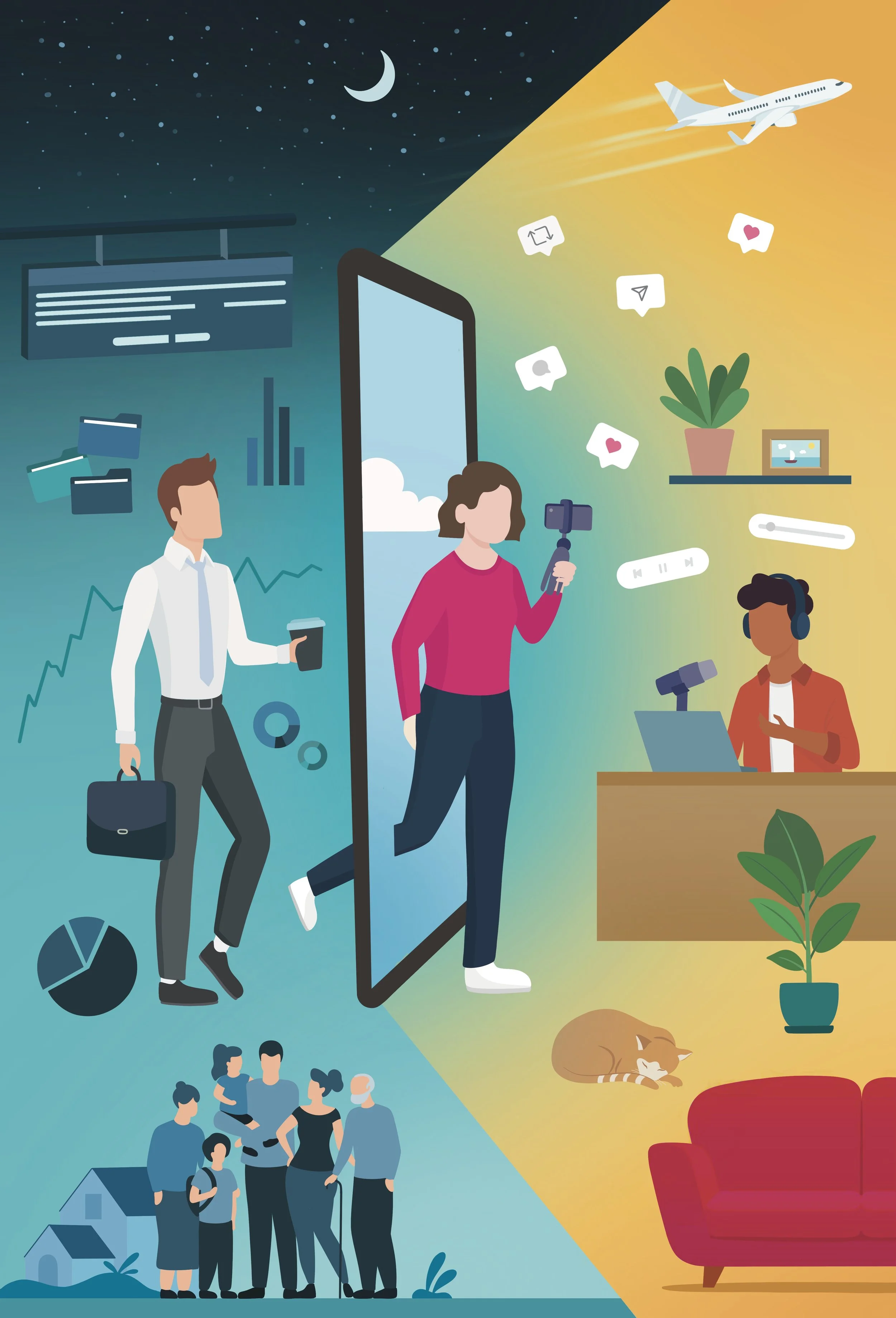
What is a generation? Merriam-Webster defines it as “a group of individuals born and living contemporaneously” or “the average span of time between the birth of parents and that of their offspring”. A generation denotes a sense of collectivity and belonging – these people were born, raised and lived throughout the same period in time, and as such share the same (or at least similar) experiences and cultural references.
The concept of a generation and its categorisations are not new: there are Baby Boomers (1946–1964), Gen X (1965–1980), Millennials (1980–1996), Gen Z (1997–2010), and Gen Alpha (2011–2024). While for the most part we all manage to get along, what happens during this “handover” between generations? When a new one “comes of age” to enter the workforce and become an active contributing member of society? How does it begin to establish itself?
“What challenges does it face in regard to work, life and the generations that will succeed it? Will it be a war, divisive politics, civil rights, issues around identity or economic uncertainty? ”
Is overcoming them even possible when the upcoming generation doesn’t have as much to inherit? What happens when the rifts between generations – including what they want, how they operate, and how they see the world and their place in it – become so large that they’re irreconcilable?
Despite being labelled “work-shy” TikTokers, Gen Z makes up 30% of the population and will account for 27% of the workforce by 2025. There is a common misconception that this generation doesn’t want – or like to – work and will do anything to avoid it. Yet, is it not more so the case that Gen Z doesn’t want to work in the same way as the generations before it?
Compared to their predecessors, Gen Z place a greater emphasis on mental health and a work-life balance. As a result, they have been subjected to a range of articles and think pieces on their “lack of work ethic”. Should a generation be punished or painted in a certain light for not wanting to go above and beyond for a job? Or for carving out a career path that doesn’t follow the same trajectory as previous generations?
Then there are the new jobs that Gen Z have created. Older Gen Zs are the last people to grow up without technology right at their fingertips – some people currently in their mid-late 20s will still remember the days of dial up Internet, corded telephones, and MSN – so it makes sense that the generation as a whole has harnessed technology and found a way to monetise it. Content creation and social media influencing are not roles that existed 15 years ago, and certainly not in the way they do now. With the rapid advancement of technology, and if we look at artificial intelligence (AI) which entered mass public consciousness in 2023, new jobs are constantly cropping up. Prompt engineer and AI ethicist were not job titles even half a decade ago, let alone highly competitive roles.
As such, Gen Z are changing the workplace twice over: whether that’s knowing what they want in employment and not staying in an environment that doesn’t provide it, or redefining what a job even is.
“If it’s not the avocado toast, it’s some other frivolous financial lapse in judgement that is stopping Gen Z from getting on the property ladder. ”
It’s definitely not the fact that first time buyers in London need a deposit of £144,000 and an income of £96,000 to get a mortgage. While home ownership is not everybody’s end goal or marker of adulthood, it is for many. Yet, this definition might have to change for a generation that has been priced out of owning a home.
'You become more conservative with age.’ While this may have been true previously, it isn’t anymore. A core tenet underpinning this was the fact that people used to get richer as they aged. That’s no longer the case. The number of adult children living at home with their parents in England and Wales has risen by 13.6% from 2011 to 2021 and the oldest average age (of 25) was in London. This should come as no surprise due to the cost of living in England’s capital. Those that do not live at home with their families, or meet the criteria for buying a home in London, are consigned to renting and spending a large portion of their salary on accommodation.
However, this delayed adultification is not distinct to the UK; more than 30% of adults (aged 18–34) lived in their parents’ home in 2021, in 24 out of the 29 European countries studied. This figure rose to more than 70% in countries such as Croatia, Greece, Portugal, Serbia and Italy. If this notion of adults (in the truest, physical sense of the word) staying at home longer is a widespread phenomenon, then news of declining birth rates in the West should not come as a shock.
The home ownership rates of Gen Z and Millennials are in direct contrast to that of the generations that preceded them. A U.S-report conducted by real estate company, Redfin, found that in 2023, 26.3% of Gen Zs owned a home compared to 54.8% of Millennials, 72% of Gen X and 78.8% of Boomers. Perhaps this is due to there being more housing, it being affordable, lower mortgage rates and house prices, as well as wages conducive to home ownership that enabled previous generations to get on the property ladder. The housing crisis is a point of contention between those that have and those that do not, and the landlord versus tenant debate also often manifests itself along generational lines.
While calling out discriminatory behaviour or language and setting your parameters of interaction appears to be an alien idea to some, this is the norm for Gen Z. However, not every group feels this way or understands – or even tolerates – their need to challenge the status quo. Whether that’s attitudes towards racial and gender identity, sexuality, immigration and refugees, the environment, or social media consumption, the soon-to-be incumbent generation of adults refuses to be silenced.
All generations have their “defining moment”, yet it seems as though Gen Z has had several. Although the oldest member of this generation is only 27, they have already lived through numerous “once in a lifetime” events – from financial crises and recessions, to pandemics and government-mandated lockdowns.
“Gen Z is continuously at loggerheads with the ruling elite and has mobilised (which has also been aided by technology) to demonstrate and protest issues that will affect it and generations to come. ”
This has resulted in increased political disillusionment and mistrust in institutions such as the government or the police. There is also the sentiment that young people’s voices aren’t head when they participate (or even try to) in the existing establishment – take the 2016 Brexit Referendum, for example. The UK Government didn’t lower the voting age to 16, even though the UK’s membership in the European Union would impact this group for decades to come. Despite the majority of young people voting to remain, 52% of the electorate chose to leave. As such, we’re seeing more young people operating outside of these institutions and use their political caché in the form of protests and boycotts to try and affect change. There is a large disconnect between the old and new generations on a myriad of matters: social, economic, environmental and political.
An exasperated “young people these days” uttered by an older person is not only reserved for Gen Z. It’s likely that people from every generation have heard someone say this about them (whether that’s indirectly or not). Human nature is liking what we know and fearing the unknown.
We don’t want things to change and often reminisce about the ‘old days’. George Ball, former United States Ambassador to the United Nations, called nostalgia a “seductive liar”. So, while things may not truly have been as good as we remember them, what was ‘good’ for one group is not necessarily good for another. When the next generation comes of age, this may all change again. While these generational gaps are to be expected, AI, technology and social media are sharpening these distinctions at a faster rate than ever before; they're also making them harder and harder to reconcile.
More concrete steps need to be taken to bring generations together to tackle the larger existential threats, like climate change, that impact us all. THP