
Between sickness & health
Written by Emily West
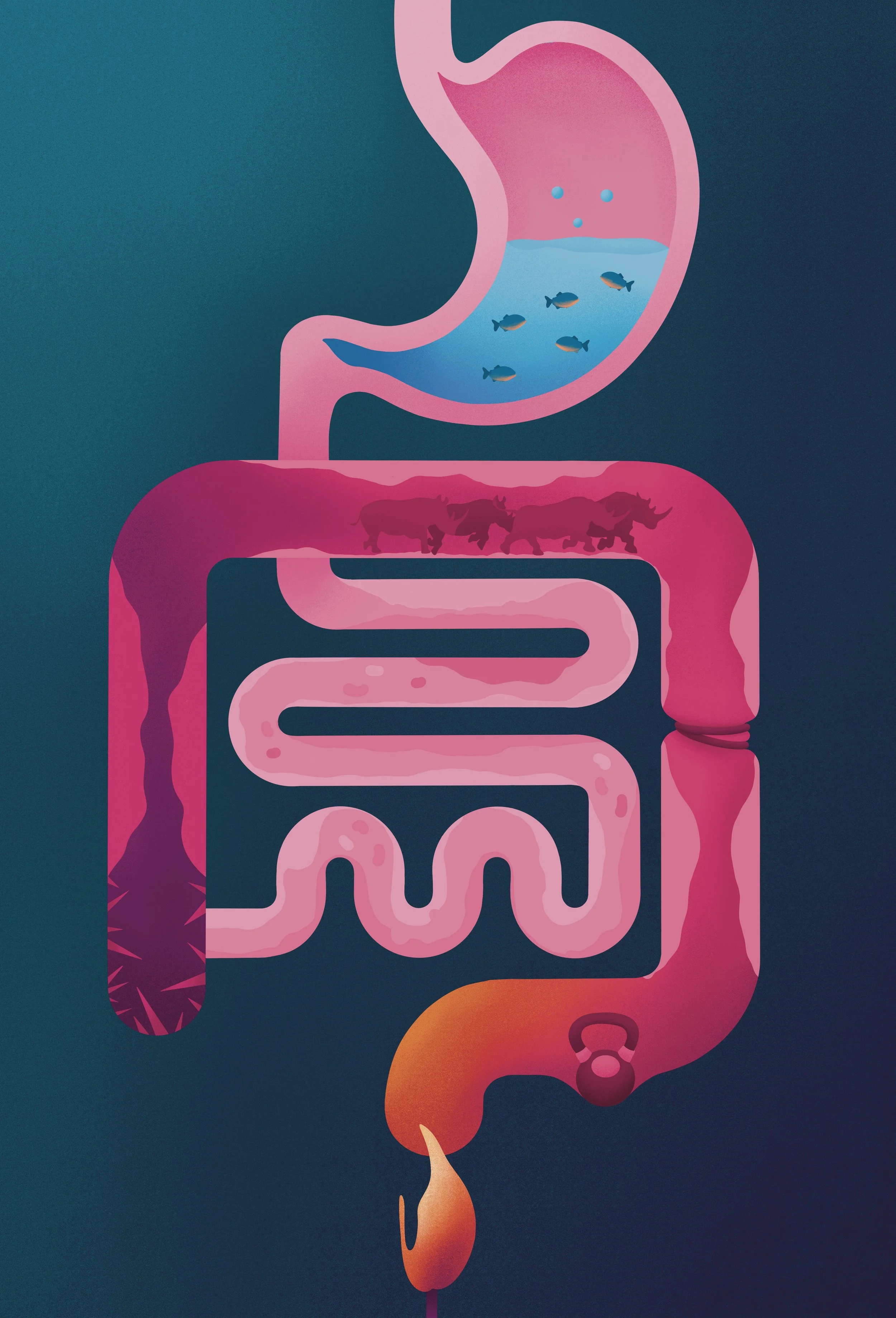
Illustration by @georgiabrownillustration
When I was first told that the theme for this issue was “Between Spaces”, one thing immediately sprung to mind. For the past 17 years of my life, I have existed in the space between healthcare access in the UK. I am not sick enough to be prioritised by doctors, but too sick to live an able-bodied life free of restrictions.
While chronic illnesses are a complex matter, and there are clinical challenges associated with treating them, it is difficult for me to remain objective when my condition impacts my every moment. This lived experience has grown into a sense of injustice and resentment, which has been difficult for me to both process and manage.
While “injustice” may seem like an over-dramatisation to some, especially given the fact we receive free healthcare at the point of access in the UK, it feels unfair that people with chronic illnesses are expected to just grin and bear it. For the average person, if they were to experience the pain, brain fog or fatigue, they would not be expected to work, function or live their day-to-day without help. However, because this is an everyday occurrence for us “spoonies”, our pain is left unaddressed, and we are made to feel as if it is our fault, and we are just being “inconvenient”.
That being said, I am also struck by a sense of guilt-inducing empathy for the under-resourced doctors and medical staff that work within the UK healthcare system, as well as my friends and family who have had to watch me live in pain. I appreciate the work they all do, especially those who dedicate their lives to saving others and are forced to ruthlessly prioritise on a daily basis. The purpose of this article is to spread awareness on what it is like living as someone who is often a casualty of that ruthless prioritisation, to promote a more empathetic attitude toward those with long-term, chronic conditions and shed light on the immense healthcare disparity that exists in the UK.
So, what can a non-life-threatening chronic illness look like? One example could be a myalgic encephalomyelitis patient, who suffers from extreme fatigue and feels as if their body is a lead weight, but who the GP advises to just, “eat some more fruit and veg”. A second could be a woman with endometriosis, who can’t move without feeling like they’re either being stabbed or about to faint, but who is told that: “period pains are normal for women”. A third could be someone with high-functioning mental health issues, who cannot access timely therapy or the right medication for them without having to jump through hoops to prove they are “mad enough”.
Another could be the 8-year-old me, who was discharged from hospital early because the staff needed the bed for a “worse off” patient, after I was still recovering from a major blood haemorrhage. Or I could look at 18-year-old me, being refused care from A&E when I had a bowel obstruction because I had alcohol in my system. Or even 24-year-old me, who sat in A&E for 12 straight hours waiting to be seen, but constantly being denied pain relief because “someone is dying in the next room”.
“When I reflect back on those times, the world seems cold and uncaring in the light of so much pain. ”
The ripple of impact that being in this “between space” has is so much wider than just the individual. I think of my parents, stifling sobs in the next bedroom before my diagnosis. They were scared I was dying and could not understand what was taking so long to inspire action in the doctors. I think of the relief and gentle unravelling of my father when he heard the words “It’s not Leukaemia” followed by the wide eyes of my mother gazing into the black hole of the scary unknown asking: “What is Crohn’s?”. I remember my brother giving me sketch of Tigger from Winnie the Pooh, with “I hope you get your bounce back” written underneath. I was only 9 years old when this happened. At that age you don’t really understand that the world doesn’t revolve around you, and life doesn’t care whether you get upset or if your parents cry.
Many of the situations I have outlined so far have been pre-diagnosis. But shockingly, it didn’t get much better once the doctors knew I had a chronic illness. I was diagnosed 17 years ago but still struggle today with gaining timely care. The longer you live with a condition, the more it becomes the norm – not just for you but for those around you. You begin to hold yourself up to unrealistic standards, burning the candle at both ends, to prove that you are just as worthy as your able-bodied peers. And at some point, you kind of forget that it’s not normal. It’s not normal to need opioid medication every other day, or to burn your skin with hot water bottles, or not be able to stay awake for more than 9 hours at a time. Because the NHS is so under resourced, you can go months or years without an appointment, talking to a professional or being checked on.
While my personal anecdotes relate to Crohn’s, my work as a patient advocate has highlighted that a lot of people with chronic illnesses, particularly autoimmune conditions, feel a similar way. Often, they express the most gratitude for the NHS and health services. Despite the fact it can be frustrating when you are not seen quickly, and no one seems to be listening to your worries, we are around NHS workers for enough of our lives to see that these are good people, doing good jobs and trying their best to succeed in an inefficient system.
“So why, if we are blessed to have free healthcare from good people doing good jobs, are so many chronically ill patients in the UK feeling deprioritised, overlooked and in some cases, medically “gaslit”? ”
Firstly, we are very lucky as a nation to have free healthcare. The NHS has to deal with the impossible challenge of caring for 66.97 million people with a workforce that is chronically underpaid, under resourced and over-worked.
Alongside government budgets not being up to scratch, extraneous variables constantly stretch the service further year on year: the UK’s ageing population, public sector austerity, staff shortages, the list goes on. When compared to other high-income economies, the UK is below average in terms of spend per person on health.
We also have fewer hospital beds, staff and equipment per capita. But I’m probably not telling you anything you do not know, or at least have not heard quoted at one point or another.
Another huge factor that reduces access to care is the digital triage system in the UK, which has only worsened since the pandemic. While on one hand, prioritising appointments for those who are in more dire need of seeing a medical professional sounds sensible, the approach does not consider those who have communication difficulties or those who do not have access to WiFi or a phone. Even if you do manage to book in with a GP for your symptoms, the journey to diagnosis is long and difficult (as an example, on average, autoimmune patients see four different doctors over a 4-year period). This lack of prioritisation can be a dehumanising and shameful experience; it can feel like you’re being told, “if you’re not dying, we don’t care”. This is despite extensive research that shows that early intervention could save the NHS millions, improve quality of life and increase survival rates.
Take my condition, Crohn’s, as an example. While not life threatening on its own, there have been cases of people dying from the complications that occur when they are not being consistently treated, such as bowel obstructions, sepsis or a lowered immune system.
“While this is rare, for me, even one person dying from something so heartbreakingly avoidable is too much. ”
Although many people living with chronic long-term illnesses are subjected to this purgatory, I would be remiss not to highlight some key demographic factors that can contribute to being “in between” the spaces of healthcare access.
First, existing stigmas and pre-conceived ideas, even from trained professionals, can have disastrous effects on patients, particularly those with mental health conditions. A study of patients with anorexia uncovered that many patients felt their doctors, friends and families did not understand how ill they were, especially if they did not present as severely underweight. Of course, mentally ill people deserve timely care for both their mental and physical illnesses, but one can not deny the personal biases that everyone, including healthcare professionals' have. If you’re constantly forced to prioritise who to treat and who to care for, those with mental health disorders who may have a history of being ‘histrionic’ or ‘anxious’ may be more likely to be take a back seat. This can lead to misdiagnosis and incorrect treatment. The misdiagnosis rate for those with a major depressive disorder may be as high as 65.9%.
Another key demographic I’d like to touch on is gender. Women are more likely to experience medical gaslighting. This has been true throughout history, with the word ‘hysterical’ literally coming from the Greek word ‘hysteria’, meaning uterus. Why do women receive such a sub-standard level of healthcare?
There are a few potential factors. First, while many common chronic conditions are not female-specific, they can occur at substantially higher rates in women compared to men. Second, the “the one size fits men” approach to medical research has caused a knowledge deficit that impact the prescribing habits of doctors and the efficacy of women's treatment. And third, it may just be good old-fashioned sexism.
Younger me can give an example of this. I first started struggling with my mental wellbeing as a result of my chronic health condition at age 13. I was going through puberty, which was mistakenly assumed to the key factor behind my emotional state.
Being told that what I felt was “normal” lead to a period of time where I suffered alone, without any support. I became convinced I was just being an overly dramatic adolescent, which lasted until age 21, when I had a nervous breakdown.
While I was once again humbled by the love shown by my family and friends, it did make me wonder – in a world where there is “always someone more ill” than you, is anyone actually being treated?
There is a real unmet need for everyone fighting long-term chronic illness that does not have immediately life-threatening symptoms. These people need to have access to better quality care and information, timely treatment and real, effective psychological support.
If chronically ill patients had better access to these things, the risk of comorbidities would plummet, patients would feel more empowered and knowledgeable to provide themselves with quality self-care, and overall, the burden on the NHS would be significantly diminished.
Empathy and trained, professional listening leads to patient empowerment, earlier identification and diagnosis, better health outcomes, and less expensive and time-intensive interventions being required. Recognition of this issue is paramount. We all need to be more attentive, curious and advocative in our attitudes towards invisible disabilities. Sick people should never be ignored.