
A very British breakup
Written by Paul Alex Treadaway
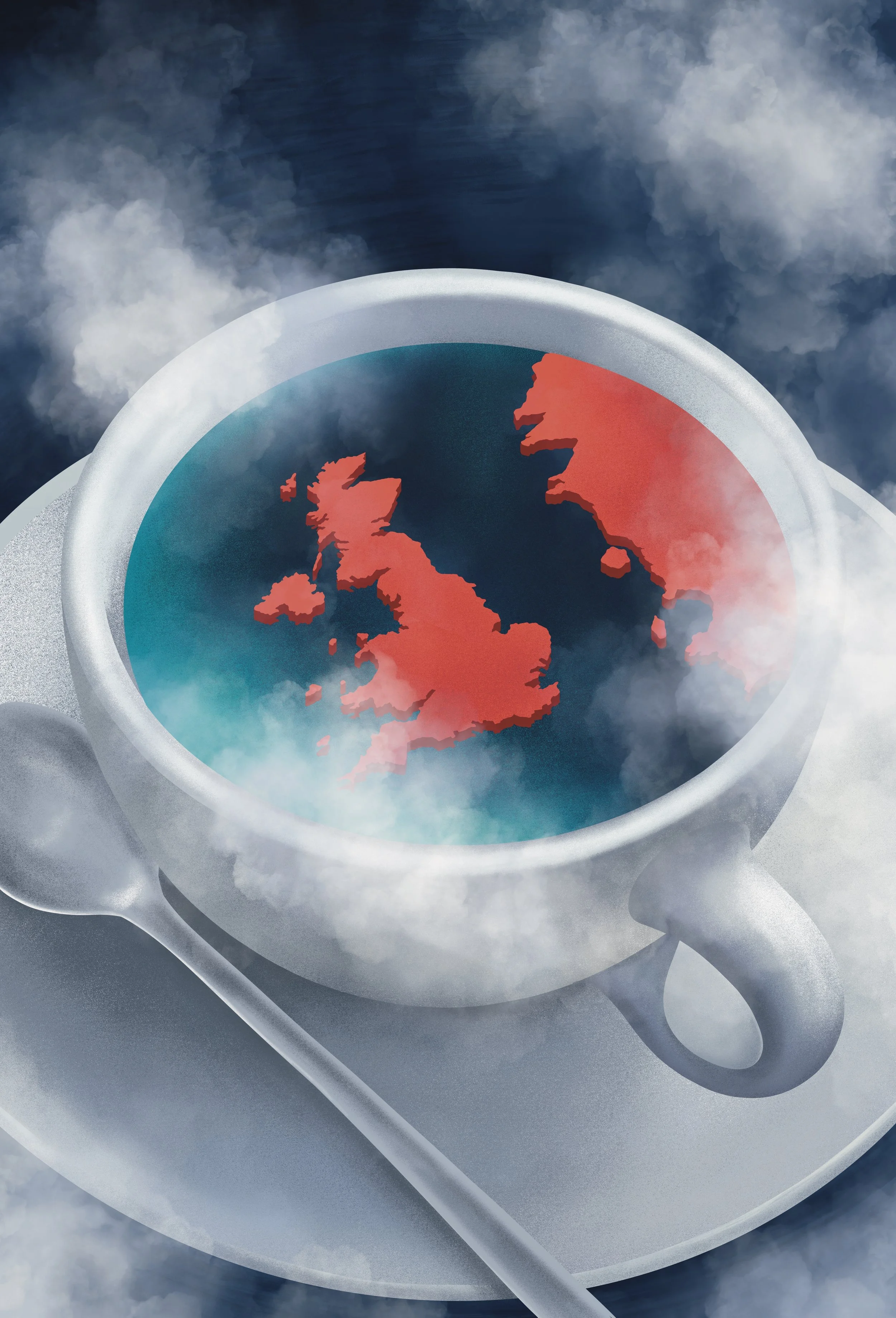
Illustration by @georgiabrownillustration on Instagram
Marmite. Wallace and Gromit. Composing single sentences so ridiculously long that they read as if I’m constantly trying to hit a word-per-day quota. These are just some of the parts of me which are unmistakably, irrefutably and quite distinctly – British. Not quite in a white and red St. George’s flag kind of way, or even in the intrinsic need to find a horribly branded pub abroad kind of way – I’m by no means a nationalist – but there is something about where we, our families and our friends call home that makes up a much larger chunk of us than we’d often care to admit.
The idea of nationality is in many ways a bizarre concept. The world is ever more fluid, and cultures are continually melting together to form a new “mainstream”. As a result, many of us feel as though we are caught between spaces. It’s almost as if we’ve been fired from a cross-cultural confetti cannon and sent plunging into a heaving crowd of people, where identity is pulled like a stretch armstrong this way, and that way.
Amidst the chaos and blurry lines, it can be challenging to know where you stand when it comes to answering the question: “who am I?”. It can altogether be tempting to shut your eyes and pretend that it doesn’t really matter. I’ve certainly done that before, but the older I get, the more I feel that I’m finally ready to look at myself in the mirror and let my own reality stare back at me.
I’m a lapsed Brit, with a genealogical jar of Canadian maple syrup on the shelf, who has been built and moulded by the world inside the M25. The twist? I’ve now dipped my toes in the water on the outside. I live a life between spaces and between personalities, having exiled myself from Britain to gradually piece my cultural face together again – in Canada. For a good while, I didn’t want to face the idea that I’d left where I had called home, or the uncomfortable, confused nationality conversation that comes with it like a superfluous side-dish.
However, the slice of your personal identity that comes from so-called “nations” is still strangely profound and immeasurable – and I know that now more than ever.
For a long time, I didn’t give it a second thought. Growing up, I always felt lucky to be in London – an environment where I could connect with people from just about anywhere. As a teenager in the city, it felt like not only was the world my oyster, but that I could very easily find a spot that sold oysters without too much effort. My idea of Britishness was a mosaic – constantly being added to – with the mould of what you could call my “core values” holding it all together. I’d like to consider mine to have been optimism, inclusivity and an international outlook, where everything that I considered to be quintessentially British was also wonderfully global.
Take a seemingly humdrum, run of the mill high street. Filled with shops, yes, but ones that catered to preferences ranging from Romanian pavlova to Swedish home design, Swiss chocolate to German shoes and Italian cuisine. The eclectic and eccentric mix, each element slap bang next to each other, is what, to me, being British meant. My Britain was like a Victoria sponge cake – where the vanilla flavoured top covered all, but the jam inside could be whatever you wanted.
All this talk of cake has made me hungry, but as a teenager something I was also hungry for – like anyone else that age – was identity. At a time in your life where everything feels uncertain, and change appears to happen at warp speed (like you’re on the Starship Enterprise), the last thing you want is for your surroundings to reflect that back at you. I knew what I wanted – I was changing, but I didn’t want anything else around me to change. Of course, Britain was on a rock-solid path as an outward looking, wonderfully messy nation that I happened to call home.
The calendar flips over. It reads 24 June, 2016. Brexit season. I’m trying to sleep in a bathtub that’s much too small, feeling like a fish out of water in a hotel in Liverpool. Too nervous to embrace the perfectly comfortable bed in the room, I finally can’t wait any longer. It’s five in the morning, I turn on the TV and there is the ever-present David Dimbleby telling me the immortal words: “we’re out”. In my head, everything had just changed.
It’s almost 8 years since that day, but in many ways I’m still processing what it means for the UK to have left the EU. Intellectually I guess, but on a deeply personal level as well. I’m older, hopefully wiser, and probably in a better position to look back on what I did next after those fateful early hours with the rolling news screen.
At first, I felt my head spin and a billion questions circled round my synapses. I’d always imagined my future taking place in London, as it simply felt like home. But so much of what I had assumed about home had seemingly just gone up in smoke.
“What was the UK going to be like, what opportunities were there going to be, and where did I fit in? ”
I’m not going to sit here and say the EU is a bastion of all things good and mighty in this world – because it isn’t. But one thing it did represent for me was a direction of travel, in some ways literally, about where the UK, the world and my life could go. A more cooperative, hopeful and integrated environment, where opportunity was the restaurant’s special of the day and possibility hung in the air like morning dew.
Suddenly, I felt I was in mourning for a future I hadn’t even had the chance to live, and ashamed of the present day I found myself in. If being British now meant a rejection of looking out into the world and the inherently progressive – small p – value base I thought I shared with the UK, maybe I’d try to dilute my Britishness as much as possible. The question was what to dilute it with.
A good chunk of my mother’s family are Canadian, and I’d always held in mind the left-field possibility of going to the great white north on my own terms,
full-time. Faced with my despair at the choice I felt much of the UK had made, and the choice it had seemingly taken away from me, I made another choice. I was going back to Canada – plain and simple. Having internalized the feeling of being pushed away by Britain, I would embrace being Canadian.
It was a very British break-up, with everything said in silent tones and subtle outbursts. Over a number of years, I found myself half-apologizing for my British passport when I was abroad and constantly contextualizing it – “I wasn’t someone who voted leave”. I said that so many times that eventually I just lost count. In parallel, I drew ever closer to the idea of a Canada-shaped escape hatch – heading out to test the waters on an international exchange while at university, and experiencing the bright lights of downtown Toronto.
My accent – which I had always found to be malleable if I wanted it to be – shifted towards a transatlantic quicksand, partly by surroundings and partly by choice. It was as if I was Little Red Riding Hood, disguised under a new national cloak and running as fast as my feet would carry me, away from the big bad wolf emblazoned with a Union Jack in a years-long chase.
Press fast forward. It’s been two years since I packed up my life in boxes, said goodbye to Dover’s white cliffs. But here’s the thing – a lot has changed since 24 June, 2016. My voice still warbles to the confusion of most people I know, and I don’t for one second regret my home on shores anew. However, I do feel profoundly less angry than I now recognize I was in that post-EU referendum haze.
Part of this is a settling, a nestling into the Canadian half of my identity – not in a “everything is perfect here” fanatical hallucination, but rather more in a quiet, birds whistling gut-driven idea of home. My life is in Toronto for now, and I quite like it that way – and not for the reasons I thought I would do. My rage tears are gone, and they have been replaced by something far more adult and mellowed.
I’ve reached a peace with the reality that whatever teenage Illyrian fields concept I had of the UK a decade ago is gone, but that doesn’t mean everything within it I hold dear has vanished.
“It’s not flags or politics that tells us who we are completely, although they frequently try to.”
When I look back now at my life in London, it was my family, my friends and myself that set out the values I lived by and what I believed in, the hope I had for a future then yet to be lived and the routes my life could explore.
Being British for me is no longer reliant on the political winds and whims of the day – I see it instead in my own face every time a Canadian born-and-bred friend makes a joke about a cup of tea, and I humorously correct them that I prefer coffee. No matter how far I go, what other parts of my own identity I explore, I will always be between spaces. These days, a huge chunk of me is a warm-accented Canadian, but a good dollop sized splodge is a now reconciled Brit. Each half lives side-by-side in my mind – like an awkward sort of room-share.
Someone once said to me that you never quite get over losing a loved one, but that you learn to live with it. I listened to a podcast last month which stated that Britain’s relationship with Europe was only ranked seventh in a list of pressing concerns for the British public in the build up to July's general election (bye bye Tories!). This is in sharp contrast to the 2019 election, in which the “Get Brexit Done” mantra drowned out all others.
For me this doesn’t mean all is said and done, it simply means we – and I very much include myself here – have learned to live with Britain as it is now. That said, I find it a lot easier to do that looking from the outside in.
If a scattergraph had been hooked up to the UK over the last decade, it very well may have run out of steam. The chop, change and never-ending political whirlpool has been exhausting to watch, even from afar and I’ve been saddened, torn and conflicted all at once. Sometimes it feels like a confirmation – that walking away was the right move. Even my most chaotic Toronto days aren’t as wild as the average day across the pond. But that doesn’t mean my heartstrings aren’t tugged as I glance back at what I’ve got left.
This isn’t an “I told you so” – in fact, quite the opposite. It’s been all the harder to witness the place that I grew up in go through a similar identity crisis to the one I’ve found myself in, as both Britain and I discover life is often messier than we want it to be. It's a weirdly symbiotic relationship that I know now I can’t get away from, no matter how many miles there are between us.
So, where does Britain and I’s relationship go from here? I honestly don’t know. The UK has got a lot of decisions to make about who it wants to be as a nation. Although, after the pain and anguish of what felt like a deep-cut divorce from my British self, I can finally now share custody of a new Britishness, born from the UK but most certainly with my eyes and nose. Between spaces – and I’m alright with that.