
Right here, right now
Written by Fin Harrison
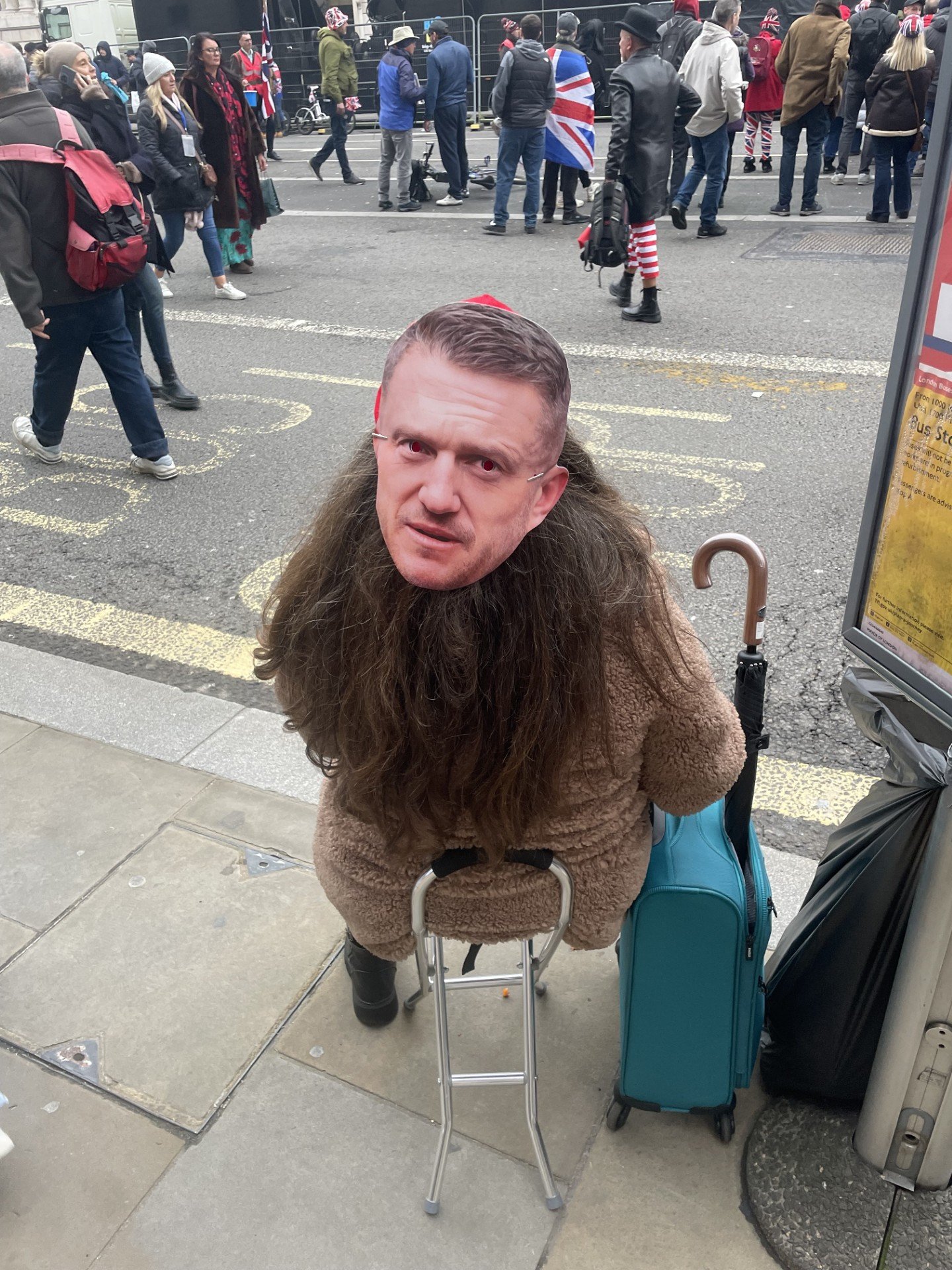
It’s Saturday, the first of February, and I’m getting ready to step into what I previously understood to be a small but explosive ecosystem that lived on the fringes of society. I’m off to Westminster, to investigate the goings on at the Stop the Isolation demonstration, a.k.a the Tommy Robinson carnival. While it’s not been uncommon for this kind of protest to take place in the UK, it’s the timing and the context of this one that intrigues me so much. With Trump back in the White House, this time with Elon Musk by his side, the hard right is experiencing a tectonic surge of support worldwide.
“Although it’s been a wild ride for right wing politics over the last decade, 2025 is shaping up to be uncharted territory. ”
Zealous and extreme organisations have always existed in the UK; however, they have historically been divided between multiple factions. Groups like the National Front, The Union Movement, the BNP, Britain First and the English Defence League all made the occasional headline, but never managed to come anywhere close to real political power. For better or worse, the voice of the British right has belonged exclusively to the Tories and their institutional allies. But today, one can’t help but feel like the party’s over, and the afters has begun. Gone are the days of Oxbridge pleasantries, nuance and formality. Here come the hardcore. The last men standing.
The Conservative Party’s crushing defeat in the last election might, in more conventional times, have been almost completely attributed to Labour’s success. Not only did they bounce back from their disastrous 2019 result, but their once boastful opponents were handed their worst defeat in history. In spite of the monumental result, the atmosphere in Britain hasn’t exactly been one of Starmer-mania. In the eventful months since the election, it seems the biggest threat to the Tories’ long-held electoral monopoly over the right comes not from Keir Starmer and his appeal to centre-ground voters, but from the all too infamous disruptor with his pint of lager and cigarette. Less than 6 years on from their conception, Nigel Farage’s Reform UK Ltd have, for the first time in their history, topped a national YouGov poll, seemingly plunging Britain into the murky waters of three-party politics.
For all of his flaws, Farage sure knows how to hog the spotlight. Whether it be for dining on the penises of four different species of animal on national television, or for his 37 separate appearances on the Question Time panel, the former banker always manages to find a way of keeping his name in the headlines. This was most recently showcased when he flew out to Mar-a-Lago in the hopes of getting his photo taken with the President-elect before the Prime Minister did. While he came away from this particular mission unsuccessful, he did manage to catch up with the world’s richest man, and subsequently send the world’s press into a frenzy, as rumours began to circulate that Elon Musk might be about to donate $100 million to Reform.
Unfortunately for Nige, the Farage-Musk bromance was short lived and it wasn’t long before the tech mogul was calling on Mr Brexit to resign, stating that he ‘didn’t have what it takes’ to lead the party, and even suggesting that Rupert Lowe, the MP for Great Yarmouth and former chairman of Southampton Football Club, should step up and dethrone him. But what was the spanner in the works that prevented the billionaire from going through with what would otherwise have been the biggest donation to any party in UK political history? Enter Stephen Christopher Yaxley-Lennon, known to most as Tommy Robinson, the founder of the English Defence League who is currently serving an 18-month prison sentence after admitting to breaching a High Court injunction that barred him from repeating libellous claims about a 15-year-old Syrian boy.
“Farage knows that associating himself with the ex-football hooligan probably wouldn’t be a good look for him.”
However, his adamant refusal to endorse or even acknowledge Robinson has left many of his supporters feeling betrayed, as the Venn diagram cross-section between his and Robinson’s support base is, at the very least, substantial. The ordeal resulted in a handful of disgruntled resignations from Reform councillors and has severely disappointed Musk, who among other new hobbies, has also become Robinson’s biggest cheerleader.
The Stop the Isolation rally seemed like a good opportunity to explore, and try to understand, what effect Musk was having on the momentum of far-right politics in Britain, and to examine which various factions had been brought together by the cause.
While the march that took place beforehand resulted in a small number of arrests after a clash with a significantly larger counterdemonstration, the atmosphere at the main gathering was not one of hostility. Instead, it was one of optimism, as the protestors shared the collective belief that their movement was/is on the brink of something big. Lots of people were holding plastic bags containing cans of lager and they seem to be having a good time.
I spotted a flag flying high above the predominantly middle-aged crowd that already began to answer my question. It contains a screenshot of an Elon Musk tweet from a few weeks before that simply read: ‘Free Tommy Robinson’.
Whitehall was a sea of red baseball caps, many of which bore Trump’s all too famous slogan. To my surprise, the caps had undergone a bit of an anglicised rebrand: ‘MEGA’ (or Make England Great Again).
As I wandered through the crowd, I saw a man stood alone on the edge of the masses. He wore a purple hat and proudly held up a sign that read ‘Vote UKIP’. I find this intriguing, as Farage’s abandonment of the party he helped found in 1993, along with the subsequent creation of Reform, left UKIP to fade into the abyss of political oblivion. The man holding the sign tells me ‘They’ve been through a tough time. About 5 years ago it nearly died. But now we’re up about and walking!’
This doesn’t sound utterly convincing, seeing as the party have gone from receiving close to 4 million votes in 2015 to a mere 6530 in 2024. When I ask why he’s stuck with them and not jumped ship to Reform, he immediately replies ‘Loyalty! Loyalty! I don’t abandon people when they’re down!’
It’s an interesting sight to see. A party that was once the biggest political threat that the British hard right had to offer, one that even won a European election, now finds itself relegated to the fringes of an ecosystem within which they were once the trailblazers.
Speaking at the rally is one of their former candidates, a man called Carl Benjamin, who calls himself Sargon of Akkad on YouTube. Benjamin made headlines during the 2019 European Parliament election campaign when an old tweet resurfaced, in which he wrote ‘I wouldn’t even rape you’ in a reply to Labour MP Jess Phillips, which he then later followed up with ‘With enough pressure I might cave’. Charming! Still, to see him speaking here feels like a bizarre full-circle moment, as it was only recently that Elon Musk put out a tweet in which he himself called Phillips a ‘rape genocide apologist’.
Echoing Trump’s ‘hostages’ rhetoric about the January 6th rioters, Benjamin said that ‘The Southport rioters are also political prisoners’ which was met with a couple of cheers from the crowd. He went on to talk about a ‘lack of really good leadership’ on the right, which gave me some insight into some of the factional disagreements taking place.
“When he mentioned Farage and condemned his stance on Robinson, there was a surprising amount of supportive booing from the crowd, with one audience member in front of me even shouting ‘Fuck Farage!’.”
When he gives a special shoutout to Rupert Lowe, however, the crowd curiously respond with cheers and applause.
I walked around some more. A woman had proudly zip tied an Israeli flag to her dog’s back, while a young man was giving out stickers that read ‘2 Tier Keir’, alongside an AI-generated image of Starmer wearing a turban and a t-shirt that read ‘I love gang rapists’.
He told me that Elon Musk had done huge things for the movement, primarily citing the fact that one retweet from ‘the smartest man on the planet’ meant that over 130 million people had viewed one of Robinson’s documentaries in a single day. Whenever I asked anyone at the protest about Musk, their response was always mainly to do with retweets and exposure.
There were also a lot of ‘I Am Tommy’ stickers being plastered all over the place, and one man was dressed head-to-toe in a Gladiator-inspired costume, with a cross of St George and Robinson’s name written along the front of his armour. ‘It’s about fighting for freedom’ he tells me, ‘Spartacus was a slave. Tommy Robinson has been enslaved, and he’s being tortured.’
As I finally decided to head home, I heard the distant voice of an Indian lady stood up on stage, trying her best to get the Tommy Robinson chant going. I wondered how she had got there, and what decisions in her life had led to her being on that stage and making that speech.
I don’t know if I managed to answer my question or not. Overall, the protest made me think about just how far the tectonic plates of the UK’s far-right rhetoric have shifted. That same weekend, the former Home Secretary, Suella Braverman, made a speech at an American think tank, where she discussed the possibility of the UK becoming a nuclear-armed Islamist state within the next 2 decades, preaching, in no uncertain terms, about the great replacement theory. Although she seems to badly want to attach herself to the Trumpist bandwagon, I’m not sure they want her as part of the club. The de facto Vice President seems to have paid her little attention, choosing instead to throw up his salutes and tweet ‘Free Tommy Robinson’ as he struts around the Oval office.